Phālguna · Śukla Pakṣa
Āmalakī Ekadasi
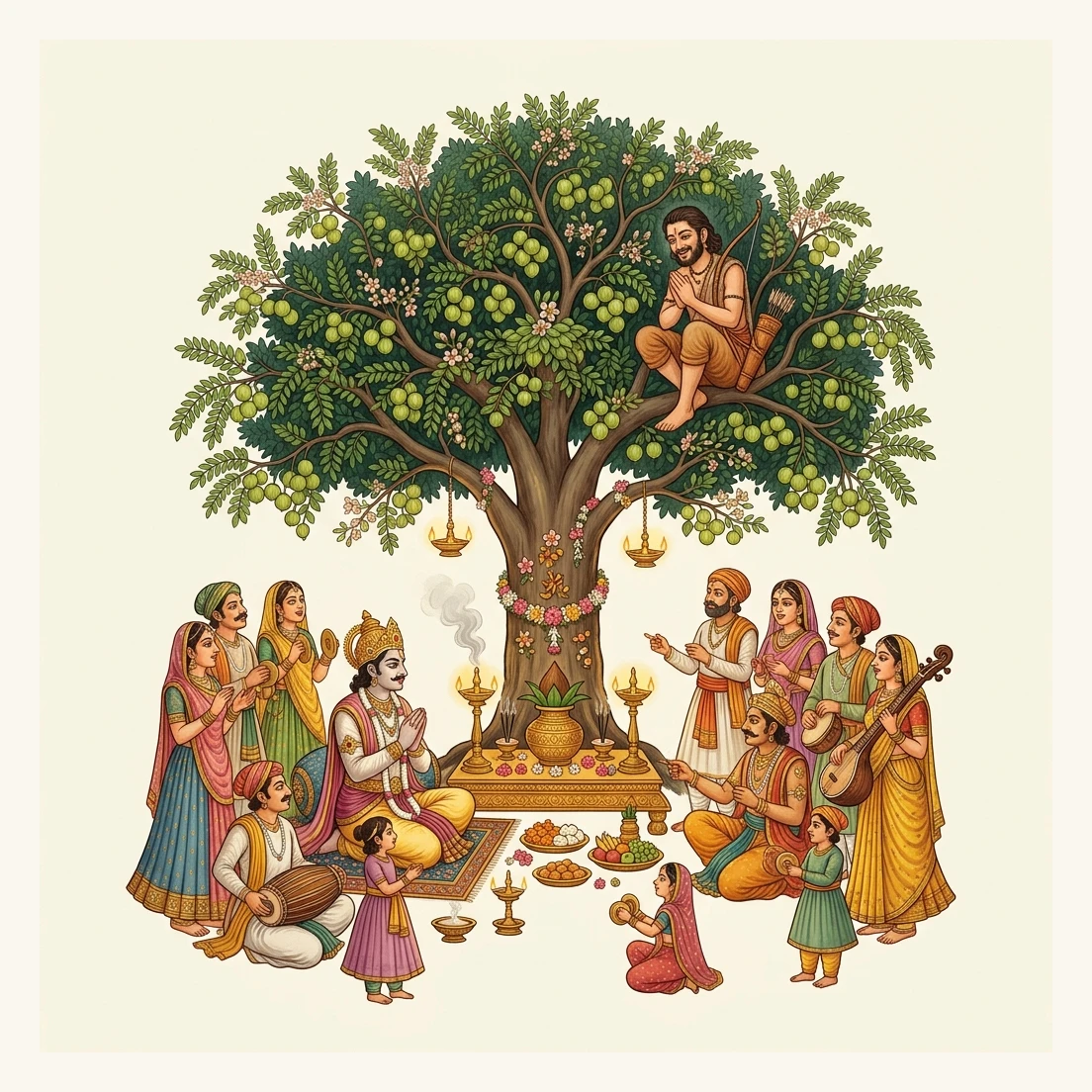
The amalaki tree
Next observedFriday, 27 February 2026
Next occurrence
Friday, February 27, 2026
- Ekadasi tithi
- Thu
- 26 Feb
- 2:03 PM
- Dvādaśī begins
- Fri
- 27 Feb
- 12:03 PM
- Hari Vāsara ends
- Fri
- 27 Feb
- 12:03 PM
- Pāraṇa window
- Sat
- 28 Feb
- 7:06 AM – 9:55 AM
The tree that grew from a god's spittle
Retold from the Padma Purāṇa, Uttara Khaṇḍa, Chapter 45. The standard English translation, on which this retelling relies, is by N.A. Deshpande (Motilal Banarsidass).
Kṛṣṇa tells Yudhiṣṭhira a story Vasiṣṭha once told the great emperor Māndhātṛ.
Māndhātṛ had asked the question. When did this Āmalakī spring up? Why is it pure? Why is it the destroyer of sins? Due to what would a man obtain the fruit of giving a thousand cows by keeping awake under it?
Vasiṣṭha answered with a cosmology.
Before this world, there was a dissolution. All of it was just ocean. The unmoving and the moving had perished. Gods, demons, serpents, fiends — all had disappeared. Viṣṇu, the highest soul, had withdrawn into his own ground — into Brahman, the changeless. Even Brahmā had become silent.
But Brahmā was, somewhere, awake.
And from his spittle — kept upright in the dark by his own keeping-awake — a single drop fell. It was lustrous like the moon. It fell onto the earth, which had not yet been called earth. From that drop the great Āmalakī tree was born, with many branches and twigs already bent under the weight of its fruit.
The Purāṇa makes a claim about this tree that is not made of any other plant in Hindu cosmology. It was declared as the first shoot among all the trees. Before everything else that grew, the Āmalakī. Before mango or banyan or fig or palm, the dhātrī — the nurse, the supporter, the one who held — was already there, fruiting.
Then Brahmā created the rest. Gods, demons, gandharvas, yakṣas, serpents, the great sages.
These created beings came together at the tree, surprised to find it standing there before them. They circled it, amazed. They did not know what it was. We do not know this tree, they said to each other.
A voice spoke from the air.
This excellent tree is Āmalakī, said to belong to Viṣṇu. Merely by remembering it a man would get the fruit of giving a cow. By touching it one's religious merit is doubled, and by wearing it tripled.
The voice continued, and what it described was a tree that was also a whole cosmos:
At its root lives Viṣṇu. Above it stays Brahmā, the grandsire. In its trunk the revered Rudra lives. All the sages live in its branches. The deities live in its twigs. The gods remain in its leaves. The Maruts in its flowers. All the lords of created beings are settled in its fruits.
The tree was inhabited. The tree was a vertical universe.
We do not know who you are, the sages asked the voice. Are you a god or someone else?
I am that ancient Viṣṇu, the voice answered, who is the creator of all beings and all worlds.
The sages prostrated. They asked for a vow. Tell us a vow which gives heaven and salvation, which gives wealth and grains and religious merit, which requires little exertion and gives many fruits.
And Viṣṇu gave them this Ekādaśī.
In the bright half of Phālguna, he said, when the Dvādaśī falls on the Puṣya lunar mansion, the Ekādaśī before it is the auspicious one. Go to the Āmalakī tree. Keep awake there through the night. You will be free of all sins and obtain the fruit of giving a thousand cows.
The vow
Āmalakī Ekādaśī is observed on the eleventh tithi of the bright fortnight of Phālguna. The fast is broken on Dvādaśī. The full power of the observance is held to come when Dvādaśī coincides with the lunar mansion Puṣya.
The chapter describes the ritual in detail. Fast on the Ekādaśī day. The next day, clean the teeth and pronounce the words O lotus-eyed one, O unfallen one, I shall now eat. Be my refuge. Do not speak to those who have fallen, to thieves, to heretics, to those who have outraged their preceptors' wives. Bathe in the afternoon — in a river, a tank, a lake, or at home — applying clay to the body first. Two hymns accompany the bath: one for the applying of clay, one for the bath itself.
Then, in fine gold, fashion a small image of the sage Jāmadagnya — Paraśurāma, Viṣṇu's sixth incarnation — weighing one māṣaka of gold, or half. Return home. Then go to an Āmalakī tree with all the items of worship. Clean the ground around the tree. Place a jar there, unscratched, with five gems set in it, anointed with divine perfumes, with an umbrella and a pair of sandals beside it. The jar is smeared with white sandal. A wreath hangs from its neck. Incense burns. Lamps are kindled around it in a series. On the jar is placed a pot full of parched grain. On the pot is placed the small golden image of Paraśurāma.
The image is then worshipped part by part — sixteen of Viṣṇu's names invoked over sixteen parts of the body. Salutation to Viśoka at the feet. To Viśvarūpin at the knees. To Ugra at the thighs. To Dāmodara at the waist. To Padmanābha at the belly. To Śrīvatsadhārin at the chest. To Cakrin at the left arm, Gadin at the right. Vaikuṇṭha at the neck. Yajñamukha at the mouth. Viśokanidhi at the nose. Vāsudeva at the eyes. Vāmana at the forehead. Rāma at the eyebrows. Sarvātman at the head.
A white fruit is offered. The night is kept with dance, song, instruments, religious tales, and praise. Then the tree is circumambulated 108 times — or 28, if 108 is not possible — while Viṣṇu's names are repeated.
In the morning, the worshipper waves a light before the image, honours a brāhmaṇa, and gives him all of it, saying: In the Jāmadagnya pot there are garments and sandals. May Keśava, in the form of Jāmadagnya, be pleased with me. The Āmalakī tree is touched, circumambulated again, and the observer bathes, feeds brāhmaṇas, and eats with their fraternity.
The phalaśruti
There is no doubt, the chapter says, that the observer gets the fruit which is had at all the holy places, by means of all kinds of gifts, and which is greater than that of all sacrifices.
But the deeper teaching of this Ekādaśī is the cosmology of the tree itself. The Āmalakī is not a symbol. The Āmalakī is a tree in which Viṣṇu lives in the roots, Brahmā stays above, Rudra resides in the trunk, the sages in the branches, the deities in the twigs, the gods in the leaves, the Maruts in the flowers, and the lords of creation in the fruits. To worship this tree on this day is to worship the whole vertical structure of the world. The Āmalakī fruit you eat the day after the fast is not a fruit. It is the gathered settling of every level of existence into something small, sour, and within reach.
Source: Padma Purāṇa, Uttara Khaṇḍa, Chapter 45, "Āmalakī Ekādaśī." Translated by N.A. Deshpande in Ancient Indian Tradition and Mythology series, vols. 39–48 (Motilal Banarsidass, Delhi, ISBN 9788120838291). The full English translation is freely available at wisdomlib.org.
Frequently asked
- What is Āmalakī Ekadasi?
- Āmalakī Ekadasi is the ekādaśī tithi — the eleventh lunar day — of the waxing fortnight (śukla pakṣa) of Phālguna. Its name means "the amalaki tree". Like every Ekadasi, it is observed by fasting and remembrance of Lord Viṣṇu. The story and fruits (phalaśruti) of Āmalakī are recorded in Padma Purāṇa, Uttara Khaṇḍa, Chapter 45.
- When is Āmalakī Ekadasi observed?
- Āmalakī Ekadasi falls on the ekādaśī tithi of the waxing fortnight of Phālguna (the Hindu lunar month). The exact Gregorian date varies each year because the lunar calendar drifts relative to the solar one. Smārta and Vaiṣṇava observers occasionally fast on different civil days when the tithi spans two sunrises — see the date above for the next occurrence.
- Who is worshipped on Āmalakī Ekadasi?
- Āmalakī Ekadasi, like all Ekadasis, is dedicated to Viṣṇu (as Dhātṛ, residing in the Āmalakī tree); Paraśurāma (Jāmadagnya). Specific forms of worship vary by tradition: chanting Viṣṇu-sahasranāma, reading the corresponding chapter from Padma Purāṇa, Uttara Khaṇḍa, Chapter 45, hearing the story, and remembering the divine names are all considered part of the observance.
- What is the spiritual fruit (phalaśruti) of observing Āmalakī Ekadasi?
- The Purāṇic source declares that observing Āmalakī Ekadasi yields: The fruit of giving a thousand cows, greater than all sacrifices and holy places; permanent residence in Viṣṇu's world. Across all Ekadasis, the underlying claim is the same — the fast aligns the body, breath, and mind with the eleventh lunar day's particular quietness, and bestows merit equivalent to extensive austerities, charity, or pilgrimage.
- How is Āmalakī Ekadasi observed?
- A complete observance begins the previous evening with a light, sattvic meal and continues into a fast on Ekadasi day. The fast can be nirjala (without water), phalāhāra (fruits and water), or a single sattvic meal — pick the level your health and discipline allow. Grains, pulses, onions, and garlic are universally avoided on Ekadasi. The fast is broken on Dvādaśī during the prescribed pāraṇa window listed on this page. The day is spent in remembrance — chanting, reading, hearing the Ekadasi story, and avoiding sleep during daylight where possible.
- What is the difference between Smārta and Vaiṣṇava observance of Āmalakī Ekadasi?
- On most Ekadasis the two traditions fast on the same day. They diverge only in the rare atirikta case — when the Ekadasi tithi spans two consecutive sunrises. Smārtas fast on the first such day; Vaiṣṇavas wait until the next, preferring that Dvādaśī also touches sunrise. If Āmalakī Ekadasi falls in such a fortnight in a given year, the two dates will appear on this page side by side.
Found an error?
ekadasi.day has no ads and no popups. If a date, name, or story reads wrong, please write — accuracy matters more than reach.
feedback@ekadasi.day →·Other ways to help