Jyeṣṭha · Kṛṣṇa Pakṣa
Aparā Ekadasi
The boundless
Next observedFriday, 23 May 2025
Next occurrence
Friday, May 23, 2025
- Ekadasi tithi
- Thu
- 22 May
- 3:42 PM
- Dvādaśī begins
- Fri
- 23 May
- 1:00 PM
- Hari Vāsara ends
- Fri
- 23 May
- 1:00 PM
- Pāraṇa window
- Sat
- 24 May
- 6:09 AM – 9:49 AM
The axe to the tree of sins
Retold from the Padma Purāṇa, Uttara Khaṇḍa, Chapter 50. The standard English translation, on which this retelling relies, is by N.A. Deshpande (Motilal Banarsidass).
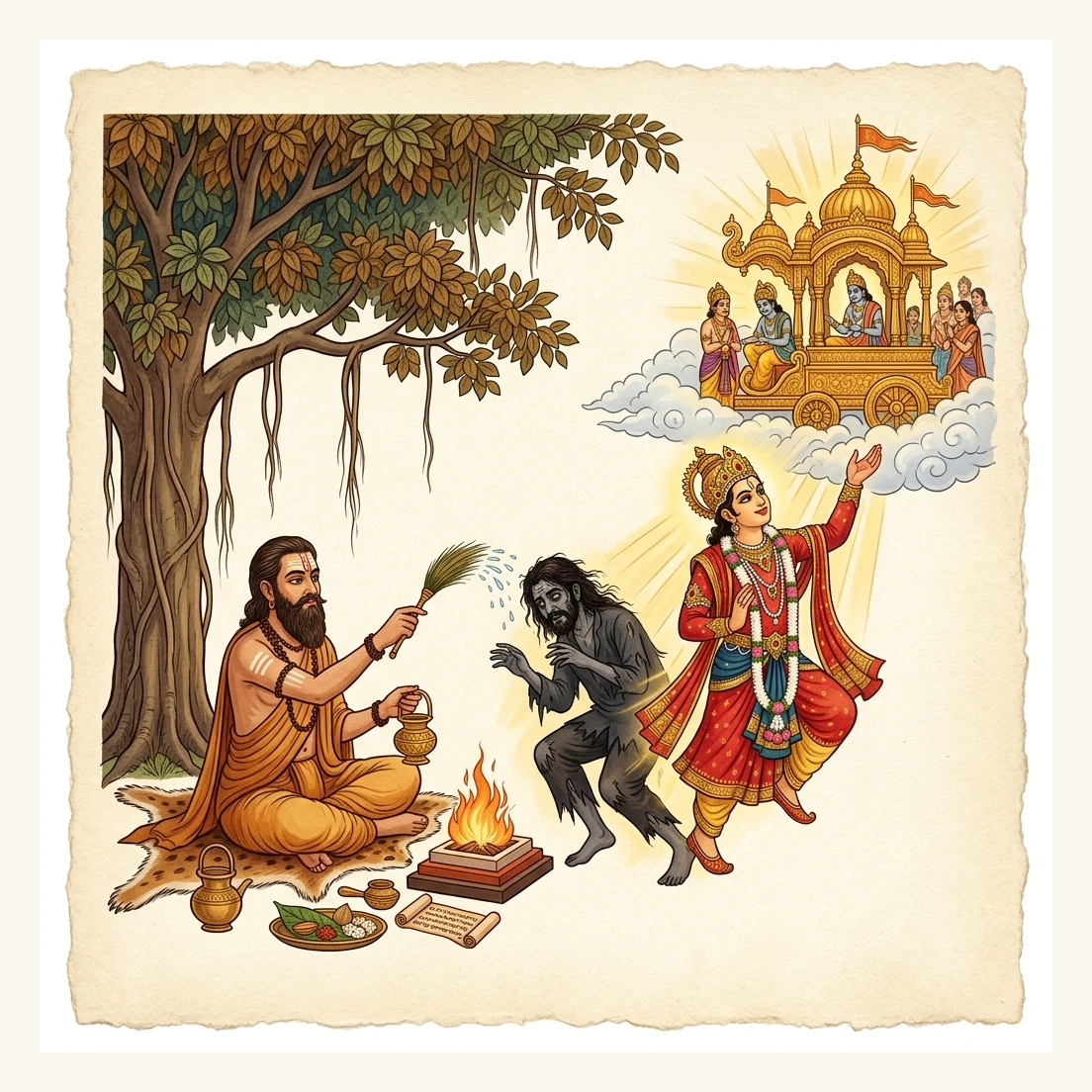
Aparā Ekādaśī has no story in the Padma Purāṇa. The chapter is shorter than the ones around it and unusual in its directness: it is a list of who is freed, and a series of comparisons for how much is freed.
The name means boundless — or the one beyond which there is nothing further. The chapter takes the name seriously. It does not narrate a fall and a recovery. It enumerates falls. It names them as if calling the roll.
O king, you have asked well, Kṛṣṇa says to Yudhiṣṭhira. The Ekādaśī in the dark half of Jyeṣṭha is Aparā by name. It gives unending fruit. He who observes the vow of Aparā becomes famous in the world.
Then the chapter names who comes to this vow.
He who is overcome by the sin of killing a brāhmaṇa. He who kills the members of his family. One who has procured an abortion. One who censures others. One who is interested in others' wives.
One who gives false testimony. One who uses false measures or false weights. One who would study false Vedas, or false sacred texts. One who is a fraudulent astrologer. One who is a fraudulent physician. One connected with false testimony.
Then more specifically:
A kṣatriya who, giving up the duty of a kṣatriya, flees from battle, goes — expelled from his caste — to a fierce hell. He too, by observing Aparā, sheds his sin and goes to heaven.
A learned disciple who censures his preceptor — having incurred great sins, he goes to a fearful hell. That man also, by observing Aparā, obtains good position.
The roll-call closed. The chapter then opens its great list of equivalences — what the merit of Aparā is like.
The merit of a man who observes Aparā, the chapter says, is comparable to:
The merit obtained by bathing at Prayāga in the month of Māgha when the Sun is in Makara (Capricorn). That is, the merit of the most sacred bath on the most sacred day at the confluence of the three rivers.
The merit obtained by bathing at Kāśī during a solar or lunar eclipse.
The merit of offering piṇḍas — rice-balls for the ancestors — at Gayā.
The merit of bathing in the Gautamī river when Jupiter is in Siṃha (Leo). The merit of bathing in the Kṛṣṇaveṇī when Jupiter is in Kanyā (Virgo).
The merit of seeing the holy place called Kumbhakedāra.
The merit of pilgrimage to Badaryāśrama, and of visiting the holy places along its route.
The merit of bathing at Kurukṣetra when the Sun is auspicious.
The merit of performing a sacrifice with the gifts of elephants, horses, and gold.
The merit of giving a recently-calved cow, or gold, or a piece of land, to a brāhmaṇa.
All of these, the chapter says, are equal to the merit of fasting on Aparā Ekādaśī.
Then the chapter turns to metaphor. The vow of Aparā, it says, is:
An axe cutting the tree in the form of sins. A wild fire to the fuel in the form of sins. The Sun dispelling the darkness of sins. A lion killing the spotted deer of sins.
And it offers one of the most arresting images in the whole Ekādaśī corpus. Those who are without the vow of this Ekādaśī are born to die like bubbles in water, or like ants among creatures. That is, those who do not observe the vow do not even rise to the status of a being that leaves a trace. Their lives are bubbles. They die without anyone counting.
The vow
Aparā Ekādaśī is observed on the eleventh tithi of the dark fortnight of Jyeṣṭha. The fast is broken on Dvādaśī.
The observance is the standard one. There is no special ritual described in this chapter. Fast from sunrise to sunrise. Worship Viṣṇu. Keep awake at night. Break the fast in the pāraṇa window the following morning, after honouring a brāhmaṇa.
What is distinctive about Aparā is who it is for. Most Ekādaśīs in this series come with a narrative of someone whose life was wrecked in one specific way and who was restored by this specific vow. Aparā does not narrow. It is the open-handed vow. The killer of a brāhmaṇa is welcome. The deserter from battle is welcome. The fraudulent physician — a sin we have not yet seen named in any of the previous chapters — is welcome. The Purāṇa does not gradate them or rank their crimes. It says simply: come.
The phalaśruti
Free from all sins, he is honoured in Viṣṇu's world. Reciting or hearing the account gives the fruit of giving a thousand cows.
The deeper teaching of Aparā is in its name. Aparā means boundless, beyond which there is no further. The merit is boundless. The forgiveness is boundless. The list of those welcome to come is boundless. The four metaphors — axe, fire, sun, lion — share one feature: each is a force against which what it attacks has no defence. A tree cannot resist an axe. Fuel cannot resist fire. Darkness cannot resist the sun. A deer cannot resist a lion. The vow of Aparā is the day on which sins, no matter how many or how serious, become things that cannot resist what is being offered to them.
Source: Padma Purāṇa, Uttara Khaṇḍa, Chapter 50, "Aparā Ekādaśī." Translated by N.A. Deshpande in Ancient Indian Tradition and Mythology series, vols. 39–48 (Motilal Banarsidass, Delhi, ISBN 9788120838291). The full English translation is freely available at wisdomlib.org.
Frequently asked
- What is Aparā Ekadasi?
- Aparā Ekadasi is the ekādaśī tithi — the eleventh lunar day — of the waning fortnight (kṛṣṇa pakṣa) of Jyeṣṭha. Its name means "the boundless". Like every Ekadasi, it is observed by fasting and remembrance of Lord Viṣṇu. The story and fruits (phalaśruti) of Aparā are recorded in Padma Purāṇa, Uttara Khaṇḍa, Chapter 50.
- When is Aparā Ekadasi observed?
- Aparā Ekadasi falls on the ekādaśī tithi of the waning fortnight of Jyeṣṭha (the Hindu lunar month). The exact Gregorian date varies each year because the lunar calendar drifts relative to the solar one. Smārta and Vaiṣṇava observers occasionally fast on different civil days when the tithi spans two sunrises — see the date above for the next occurrence.
- Who is worshipped on Aparā Ekadasi?
- Aparā Ekadasi, like all Ekadasis, is dedicated to Viṣṇu. Specific forms of worship vary by tradition: chanting Viṣṇu-sahasranāma, reading the corresponding chapter from Padma Purāṇa, Uttara Khaṇḍa, Chapter 50, hearing the story, and remembering the divine names are all considered part of the observance.
- What is the spiritual fruit (phalaśruti) of observing Aparā Ekadasi?
- The Purāṇic source declares that observing Aparā Ekadasi yields: The fruit of giving a thousand cows; an axe to the tree of sins; equal to bathing at Prayāga in Māgha when the Sun is in Makara. Across all Ekadasis, the underlying claim is the same — the fast aligns the body, breath, and mind with the eleventh lunar day's particular quietness, and bestows merit equivalent to extensive austerities, charity, or pilgrimage.
- How is Aparā Ekadasi observed?
- A complete observance begins the previous evening with a light, sattvic meal and continues into a fast on Ekadasi day. The fast can be nirjala (without water), phalāhāra (fruits and water), or a single sattvic meal — pick the level your health and discipline allow. Grains, pulses, onions, and garlic are universally avoided on Ekadasi. The fast is broken on Dvādaśī during the prescribed pāraṇa window listed on this page. The day is spent in remembrance — chanting, reading, hearing the Ekadasi story, and avoiding sleep during daylight where possible.
- What is the difference between Smārta and Vaiṣṇava observance of Aparā Ekadasi?
- On most Ekadasis the two traditions fast on the same day. They diverge only in the rare atirikta case — when the Ekadasi tithi spans two consecutive sunrises. Smārtas fast on the first such day; Vaiṣṇavas wait until the next, preferring that Dvādaśī also touches sunrise. If Aparā Ekadasi falls in such a fortnight in a given year, the two dates will appear on this page side by side.
Found an error?
ekadasi.day has no ads and no popups. If a date, name, or story reads wrong, please write — accuracy matters more than reach.
feedback@ekadasi.day →·Other ways to help