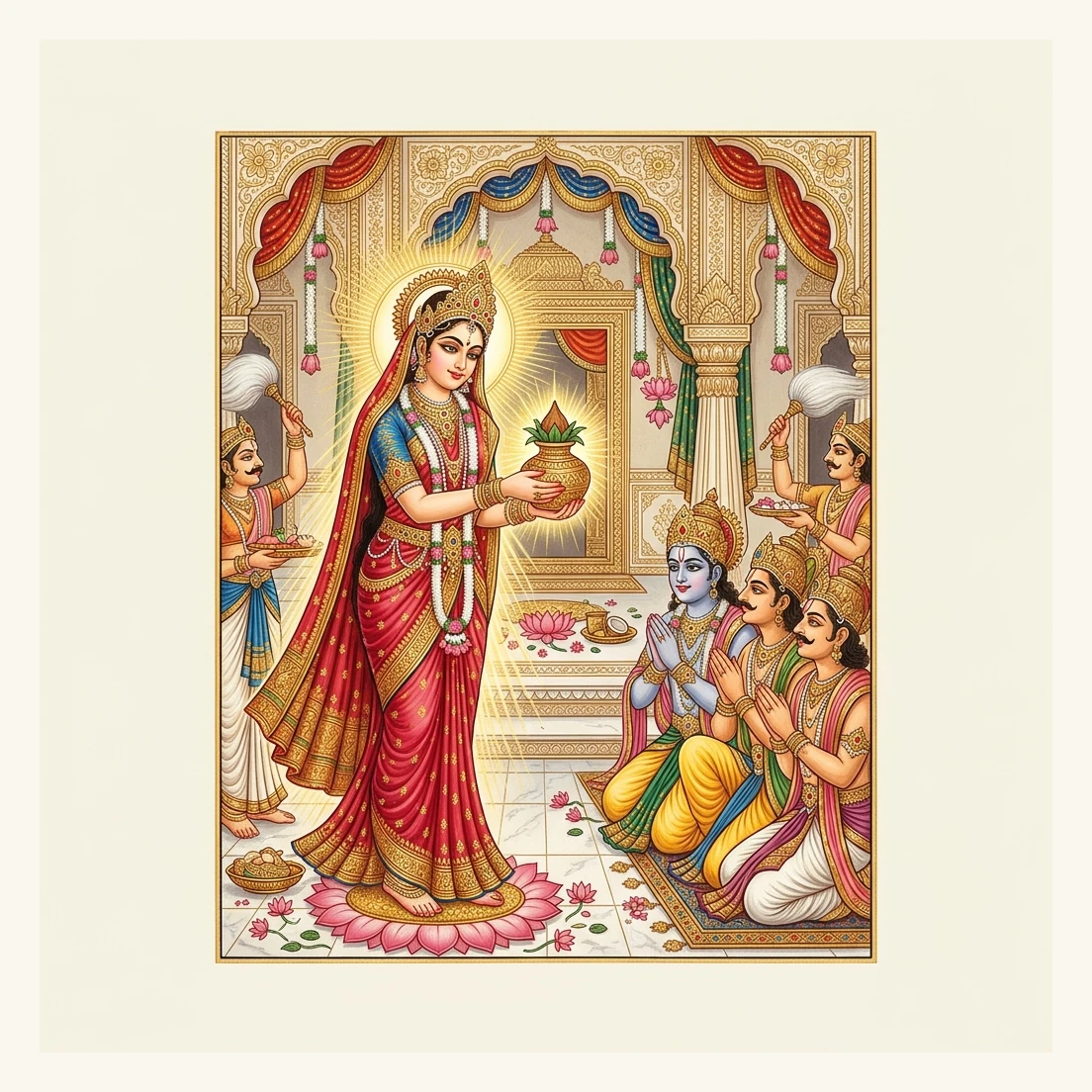
Vaiśākha · Śukla Pakṣa

Mohinī Ekadasi

The bewildering one

Next occurrence

Monday, April 27, 2026

Ekadasi tithi
Sun
26 Apr
8:37 AM
Dvādaśī begins
Mon
27 Apr
8:46 AM
Hari Vāsara ends
Mon
27 Apr
8:46 AM
Pāraṇa window
Tue
28 Apr
6:35 AM – 9:22 AM

The fifth son who came back

Retold from the Padma Purāṇa, Uttara Khaṇḍa, Chapter 49. The standard English translation, on which this retelling relies, is by N.A. Deshpande (Motilal Banarsidass).

Kṛṣṇa tells Yudhiṣṭhira a story Vasiṣṭha once told to Rāma. Rāma, the chapter explains, had asked for the story particularly because he himself had known a grief — I have experienced sorrows like the ones due to separation from Sītā. So I am scared. O great sage, I am asking you. The vow Vasiṣṭha gave him is the one that cuts through the kind of delusion that makes a man think his grief is bottomless.

On the lovely bank of the Sarasvatī river there once stood a city called Bhadrāvatī. It was ruled by King Dyutimat, of the Lunar lineage — courageous, true to his word. In that city lived a vaiśya — a merchant — named Dhanapāla. He was wealthy in money and in grain. He was wealthy also in deed: he had built public watering places, dug wells, raised temples, laid out gardens, fashioned tanks, constructed houses for the common good. He was solely devoted to Viṣṇu.

He had five sons. Four were what a father hopes for. They had names: Sumanas, Dyutimat, Medhāvin, Sukṛta. They were the wealthy man's small parade. The fifth was Dhṛṣṭabuddhi, the rash-minded, and the moral lineage stopped at him.

The Purāṇa is direct about who Dhṛṣṭabuddhi was. He was always engaged in great sins. He pursued other men's wives. He was well-versed in stories about voluptuous people — the kind of expertise that signals a wasted youth. He gambled. He longed for harlots. He did not worship deities, did not honour ancestors, did not respect brāhmaṇas. He lived by injustice and wasted his father's money. He ate forbidden food and was always drinking. He embraced prostitutes at the crossways of the city in full public view.

His father expelled him. His kinsmen forsook him. He spent through his own ornaments. Then the prostitutes who had taken his money also abandoned him, condemning him for being broke.

He stood, the text says — disturbed in mind, without clothes, oppressed by hunger — and asked himself the questions. What should I do? Where should I go? By what means shall I subsist?

The answer he gave was: I will steal. In his father's city.

He was caught. The royal officers, recognizing him as the son of Dhanapāla, released him out of respect for his father. They caught him again. They released him again. They caught him a third time, and now there was nothing for it. They bound him with strong fetters, whipped him, tormented him. The king, finally, told him: O dull-witted one, you should not live within the limits of my kingdom.

He was unbound and exiled.

In the dense forest beyond the city, he survived now as a hunter — not for sport, but for sheer hunger. He took up a bow, slung a quiver across his back, and killed whatever moved. Deer. Pigs. Spotted deer. Partridges. Peacocks. Francolins. Even rats. Then, the chapter notes pointedly, other birds too. He had become, by sheer pressure of hunger, the thing his father's house had not been able to make him: a killer of creatures who had done him no harm. He plunged into the mud of sins, the text says, due to sins committed in his former existence.

By some accident — by the acquisition of some religious merit — he wandered one day into the hermitage of a sage called Kauṇḍinya.

Kauṇḍinya had just bathed in the Gaṅgā in the month of Vaiśākha. He was returning to his hermitage. His robe was still damp.

Dhṛṣṭabuddhi, oppressed with grief, approached him. Due to a slight contact of his garment, the chapter says, his sins vanished and his misfortune was destroyed. The dampness alone, carrying Gaṅgā water from a Vaiśākha bath, was enough to cut what he had been carrying.

But Dhṛṣṭabuddhi did not yet know he was different. He fell at the sage's feet with his palms joined.

O brāhmaṇa, O greatest of the brāhmaṇas, taking compassion on me, tell me that religious merit due to the power of which salvation takes place.

The sage looked at him. He did not lecture him about all he had done. He did not enumerate his sins. He gave him, instead, a date.

In the bright half of Vaiśākha falls the Ekādaśī named Mohinī. Prompted by my words, observe its vow. When men observe a fast on this Mohinī Ekādaśī, their sins comparable to Meru, earned in many existences, perish.

Dhṛṣṭabuddhi went and observed it.

His sins vanished. His body became divine. Garuḍa came for him. Mounted on the great bird, the fifth son of Dhanapāla — drunkard, thief, killer of partridges — went to Viṣṇu's world, which is free from all calamities.

The vow

Mohinī Ekādaśī falls on the eleventh tithi of the bright fortnight of Vaiśākha. The fast is broken on Dvādaśī. The observance is the standard one — fasting from sunrise to sunrise, worship of Viṣṇu, keeping awake at night, breaking the fast on the pāraṇa window the following morning.

The name comes from mohinī — the bewitcher, the deluder, the form Viṣṇu took during the churning of the ocean. Moha is the delusion that traps people in sin. This vow's particular power is the cutting of that noose. The sages did not need to enumerate Dhṛṣṭabuddhi's sins for him; he knew them. What he did not know was that he could be released. The vow gives the release.

The Purāṇa is unusual here in saying that this Ekādaśī is given specifically to those whose situation looks hopeless. The drunkard, the thief, the abandoned son who has run out of even his prostitutes — this is the man Vasiṣṭha sends to Mohinī.

The phalaśruti

In the three worlds with the mobile and the immobile, there is nothing greater than it. The chapter is unequivocal. Sacrifices and the like, so also visits to holy places and gifts, are not equal even to the sixteenth part of the religious merit it gives.

Reciting or hearing the account gives the fruit of giving a thousand cows.

There is one more layer to the story worth noticing. Vasiṣṭha gave this vow to Rāma. Rāma is the seventh incarnation of Viṣṇu — the one who, in our reckoning of avatars, comes after Mohinī herself (the female form Viṣṇu took during the amṛta manthana). Mohinī Ekādaśī takes its name from a form Viṣṇu has been, that Rāma cannot quite remember he was. The vow returns him, in a way Vasiṣṭha can guide but cannot fully explain, to a part of himself that knew how to delude even the demons into giving up what they had stolen.

For the rest of us, the vow does something simpler. It gives back what was lost in the long dream of being someone else.

Source: Padma Purāṇa, Uttara Khaṇḍa, Chapter 49, "Mohinī Ekādaśī." Translated by N.A. Deshpande in Ancient Indian Tradition and Mythology series, vols. 39–48 (Motilal Banarsidass, Delhi, ISBN 9788120838291). The full English translation is freely available at wisdomlib.org.

Frequently asked

What is Mohinī Ekadasi?
Mohinī Ekadasi is the ekādaśī tithi — the eleventh lunar day — of the waxing fortnight (śukla pakṣa) of Vaiśākha. Its name means "the bewildering one". Like every Ekadasi, it is observed by fasting and remembrance of Lord Viṣṇu. The story and fruits (phalaśruti) of Mohinī are recorded in Padma Purāṇa, Uttara Khaṇḍa, Chapter 49.
When is Mohinī Ekadasi observed?
Mohinī Ekadasi falls on the ekādaśī tithi of the waxing fortnight of Vaiśākha (the Hindu lunar month). The exact Gregorian date varies each year because the lunar calendar drifts relative to the solar one. Smārta and Vaiṣṇava observers occasionally fast on different civil days when the tithi spans two sunrises — see the date above for the next occurrence.
Who is worshipped on Mohinī Ekadasi?
Mohinī Ekadasi, like all Ekadasis, is dedicated to Viṣṇu. Specific forms of worship vary by tradition: chanting Viṣṇu-sahasranāma, reading the corresponding chapter from Padma Purāṇa, Uttara Khaṇḍa, Chapter 49, hearing the story, and remembering the divine names are all considered part of the observance.
What is the spiritual fruit (phalaśruti) of observing Mohinī Ekadasi?
The Purāṇic source declares that observing Mohinī Ekadasi yields: Cuts the noose of delusion; nothing greater in the three worlds; sacrifices, holy places, and gifts do not equal even the sixteenth part of its merit. Across all Ekadasis, the underlying claim is the same — the fast aligns the body, breath, and mind with the eleventh lunar day's particular quietness, and bestows merit equivalent to extensive austerities, charity, or pilgrimage.
How is Mohinī Ekadasi observed?
A complete observance begins the previous evening with a light, sattvic meal and continues into a fast on Ekadasi day. The fast can be nirjala (without water), phalāhāra (fruits and water), or a single sattvic meal — pick the level your health and discipline allow. Grains, pulses, onions, and garlic are universally avoided on Ekadasi. The fast is broken on Dvādaśī during the prescribed pāraṇa window listed on this page. The day is spent in remembrance — chanting, reading, hearing the Ekadasi story, and avoiding sleep during daylight where possible.
What is the difference between Smārta and Vaiṣṇava observance of Mohinī Ekadasi?
On most Ekadasis the two traditions fast on the same day. They diverge only in the rare atirikta case — when the Ekadasi tithi spans two consecutive sunrises. Smārtas fast on the first such day; Vaiṣṇavas wait until the next, preferring that Dvādaśī also touches sunrise. If Mohinī Ekadasi falls in such a fortnight in a given year, the two dates will appear on this page side by side.

Found an error?

ekadasi.day has no ads and no popups. If a date, name, or story reads wrong, please write — accuracy matters more than reach.

feedback@ekadasi.day →·Other ways to help
Mohinī Ekādaśī · ekadasi.day