Āśvina · Śukla Pakṣa

Pāpāṅkuśā Ekadasi

The goad upon sin

Next observedFriday, 3 October 2025

Next occurrence

Friday, October 3, 2025

Ekadasi tithi
Thu
2 Oct
9:41 AM
Dvādaśī begins
Fri
3 Oct
9:03 AM
Hari Vāsara ends
Fri
3 Oct
9:03 AM
Pāraṇa window
Sat
4 Oct
7:31 AM – 7:39 AM

The hook that holds the elephant

Retold from the Padma Purāṇa, Uttara Khaṇḍa, Chapter 59. The standard English translation, on which this retelling relies, is by N.A. Deshpande (Motilal Banarsidass).

Pāpāṅkuśā Ekādaśī has no central narrative. The chapter is a teaching, and its teaching opens with the careful enumeration of who is to be worshipped.

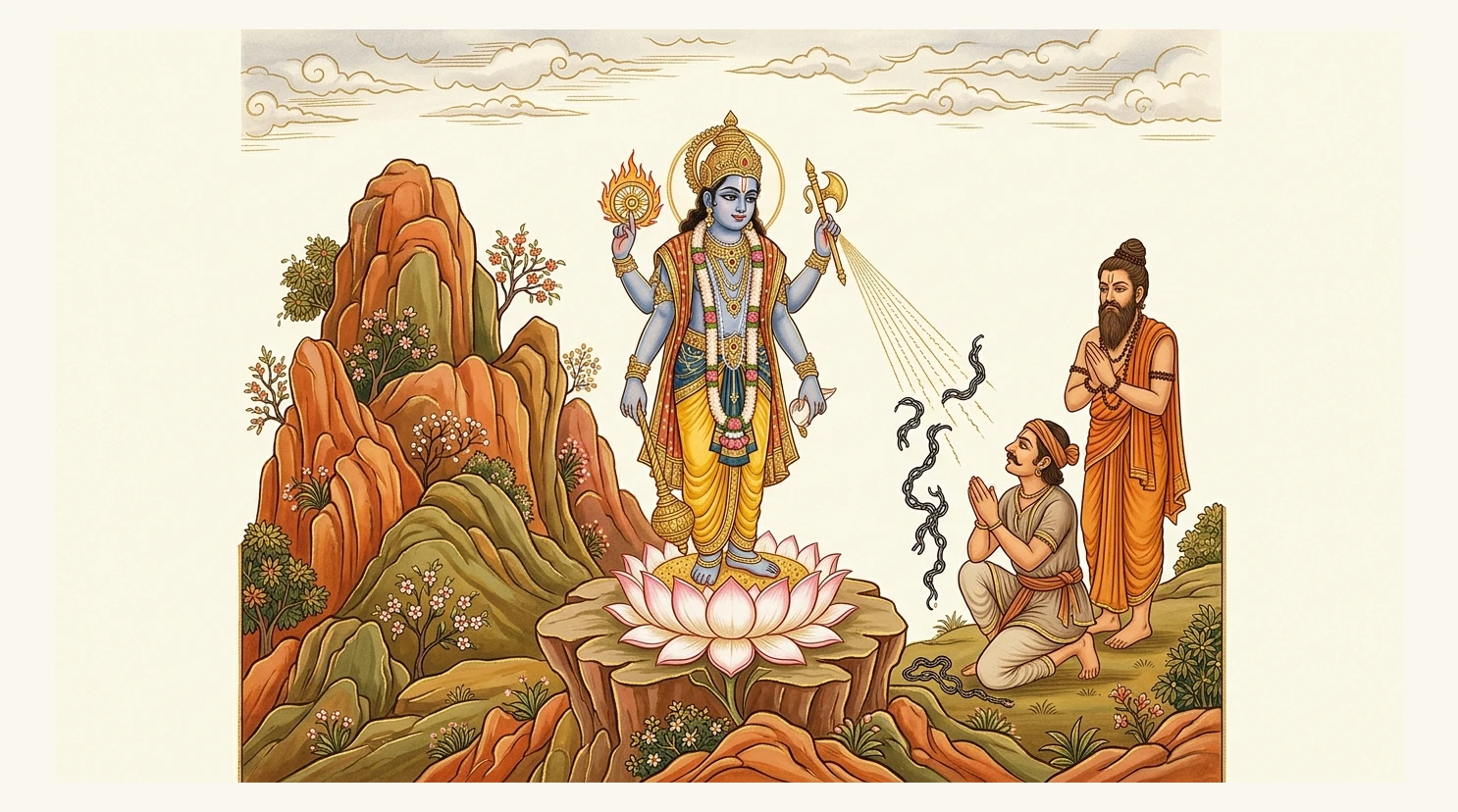
On that day, Kṛṣṇa tells Yudhiṣṭhira, a man should worship me, named Padmanābha.

Padmanābha — lotus-navelled — is the form of Viṣṇu in which the lotus rises from his navel and Brahmā sits on the lotus. The Ekādaśī is named for the discipline it imposes on sin, but the deity it invokes is the cosmic origin-point of all creation.

The name Pāpāṅkuśā breaks down as pāpa (sin) + aṅkuśa (the elephant goad, the iron hook with which a mahout controls a large beast). The vow is the hook that holds sin in place. The image is precise: sin is the elephant — large, powerful, capable of trampling everything in its way. The vow does not destroy the elephant. It holds the elephant. It commands what the body could not otherwise command.

The chapter begins with comparisons that echo what we have heard in other Ekādaśī chapters but are worth noticing for the company they put this vow in.

That fruit which a man with his senses well-controlled for a long time gets — and which leads to the acquisition of all desired objects, and which gives men heaven and salvation — is obtained by saluting the eagle-bannered god (Viṣṇu, whose vehicle is Garuḍa, the great eagle).

A man, full of delusions, having committed many sins, does not go to hell after having saluted Viṣṇu.

All those sacred places and holy abodes that are there on the earth — all of them are reached by reciting Viṣṇu's appellations.

Then a striking line in the middle of the chapter, one of the strongest statements of religious tolerance in the Purāṇic literature:

A man who, being a devotee of Viṣṇu, censures Śiva, does not go to Viṣṇu's world. He certainly goes to hell. A Pāśupata — a devotee of Śiva — who censures Viṣṇu is roasted in Raurava hell till the periods of the fourteen Indras are over.

The Purāṇa is naming, in plain language, a sin that is specific to the religious life. Devotion to one god has often, in the history of religion, slid into contempt for another. The chapter forbids this slide. A Vaiṣṇava who insults Śiva loses the very heaven he is striving toward. A Śaiva who insults Viṣṇu is sent to Raurava — the howling hell — for an unimaginable span (fourteen Indras meaning fourteen full reigns of Indra, each lasting a Manvantara of more than three hundred million years). The punishment is shocking. Its message is unambiguous: do not use your devotion as a weapon.

The chapter then lays out the comparisons:

Like the vow of Viṣṇu which destroys sins, there is no other vow in the three worlds that purifies men. As long as a living being does not fast on the auspicious day of Viṣṇu, sins remain in his body. Thousands of horse-sacrifices and hundreds of Rājasūya sacrifices do not equal the sixteenth portion of the Ekādaśī fast. There is no vow like the Ekādaśī vow. Even those who observe it under some pretext do not go to Yama.

The list of what the vow gives is generous: heaven, salvation, good health, sons, a wife, wealth, friends.

Then the chapter makes its boldest claim about reach.

A man who observes Pāpāṅkuśā Ekādaśī, the Purāṇa says, emancipates ten members on his mother's side, ten on his father's side, and ten on his wife's side.

Thirty ancestors are released by one observance.

The architecture is worth attending to. On a person's mother's side: ten generations. On the father's side: ten. On the wife's side — and only this Ekādaśī among the twenty-four extends the reach to the spouse's line — another ten. The vow that the Purāṇa calls the goad upon sin turns out to also be a reach across three families. One person fasts. Thirty are freed.

The chapter offers a final image of the observer.

Men who observe this vow have four arms, divine forms, have banners of Garuḍa, and white garments, and go to Viṣṇu's abode.

The fasted-out observer takes on something of Viṣṇu's own appearance. The four arms, the eagle banner — these are the lord's own marks.

And then the chapter offers a line that has the weight of a maxim:

He whose days come and go without meritorious acts does not, though breathing, live — like the bellows of a blacksmith.

A bellows breathes in and out. It moves air. But it has no life of its own. A day that passes without a meritorious act is a day spent in the same way — air moves, but nothing in the person making it lives. The chapter is asking the observer to take Pāpāṅkuśā as a day that distinguishes itself: one day in the fortnight when the breathing is not just the bellows of a blacksmith.

The vow

Pāpāṅkuśā Ekādaśī falls on the eleventh tithi of the bright fortnight of Āśvina. The fast is broken on Dvādaśī.

The observance is the standard one — fasting, worship of Padmanābha, keeping awake at night, breaking the fast on Dvādaśī.

What is distinctive about this Ekādaśī is its enumerated reach across three family lines. Many devotees observe it specifically with the intention of dedicating its merit to ancestors on their mother's side or wife's side — relatives sometimes left out of the more common male-line Śrāddha offerings. The vow is the inclusion.

The phalaśruti

A man having fasted on an Ekādaśī day in his childhood, youth, or old age does not face a calamity. The vow may be observed at any stage of life with equal effect.

A man observing a fast on the Pāpāṅkuśā Ekādaśī in the bright half of Āśvina is freed from all sins and goes to Viṣṇu's world.

The deeper teaching of Pāpāṅkuśā is in its name. Sin is not a thing one defeats. Sin is a thing one holds — the way a mahout holds an elephant by means of the iron goad. The body's appetites, the mind's grievances, the habits accumulated across many lives — these are the elephant. They are not removed by the vow. They are restrained by it for one day, and that restraint is the discipline that, repeated through a life, eventually changes the elephant itself. The hook is small. The elephant is large. But the hook decides where the elephant goes.

Source: Padma Purāṇa, Uttara Khaṇḍa, Chapter 59, "Pāpāṅkuśā Ekādaśī." Translated by N.A. Deshpande in Ancient Indian Tradition and Mythology series, vols. 39–48 (Motilal Banarsidass, Delhi, ISBN 9788120838291). The full English translation is freely available at wisdomlib.org.

Frequently asked

What is Pāpāṅkuśā Ekadasi?
Pāpāṅkuśā Ekadasi is the ekādaśī tithi — the eleventh lunar day — of the waxing fortnight (śukla pakṣa) of Āśvina. Its name means "the goad upon sin". Like every Ekadasi, it is observed by fasting and remembrance of Lord Viṣṇu. The story and fruits (phalaśruti) of Pāpāṅkuśā are recorded in Padma Purāṇa, Uttara Khaṇḍa, Chapter 59.
When is Pāpāṅkuśā Ekadasi observed?
Pāpāṅkuśā Ekadasi falls on the ekādaśī tithi of the waxing fortnight of Āśvina (the Hindu lunar month). The exact Gregorian date varies each year because the lunar calendar drifts relative to the solar one. Smārta and Vaiṣṇava observers occasionally fast on different civil days when the tithi spans two sunrises — see the date above for the next occurrence.
Who is worshipped on Pāpāṅkuśā Ekadasi?
Pāpāṅkuśā Ekadasi, like all Ekadasis, is dedicated to Viṣṇu (as Padmanābha). Specific forms of worship vary by tradition: chanting Viṣṇu-sahasranāma, reading the corresponding chapter from Padma Purāṇa, Uttara Khaṇḍa, Chapter 59, hearing the story, and remembering the divine names are all considered part of the observance.
What is the spiritual fruit (phalaśruti) of observing Pāpāṅkuśā Ekadasi?
The Purāṇic source declares that observing Pāpāṅkuśā Ekadasi yields: Frees thirty ancestors — ten on the mother's side, ten on the father's, ten on the wife's; greater than a thousand horse-sacrifices. Across all Ekadasis, the underlying claim is the same — the fast aligns the body, breath, and mind with the eleventh lunar day's particular quietness, and bestows merit equivalent to extensive austerities, charity, or pilgrimage.
How is Pāpāṅkuśā Ekadasi observed?
A complete observance begins the previous evening with a light, sattvic meal and continues into a fast on Ekadasi day. The fast can be nirjala (without water), phalāhāra (fruits and water), or a single sattvic meal — pick the level your health and discipline allow. Grains, pulses, onions, and garlic are universally avoided on Ekadasi. The fast is broken on Dvādaśī during the prescribed pāraṇa window listed on this page. The day is spent in remembrance — chanting, reading, hearing the Ekadasi story, and avoiding sleep during daylight where possible.
What is the difference between Smārta and Vaiṣṇava observance of Pāpāṅkuśā Ekadasi?
On most Ekadasis the two traditions fast on the same day. They diverge only in the rare atirikta case — when the Ekadasi tithi spans two consecutive sunrises. Smārtas fast on the first such day; Vaiṣṇavas wait until the next, preferring that Dvādaśī also touches sunrise. If Pāpāṅkuśā Ekadasi falls in such a fortnight in a given year, the two dates will appear on this page side by side.

Found an error?

ekadasi.day has no ads and no popups. If a date, name, or story reads wrong, please write — accuracy matters more than reach.

feedback@ekadasi.day →·Other ways to help
Pāpāṅkuśā Ekādaśī · ekadasi.day