Adhika Māsa · Kṛṣṇa Pakṣa
Paramā Ekadasi
The supreme
Next observedThursday, 11 June 2026
Next occurrence
Thursday, June 11, 2026
- Ekadasi tithi
- Wed
- 10 Jun
- 3:28 PM
- Dvādaśī begins
- Thu
- 11 Jun
- 1:06 PM
- Hari Vāsara ends
- Thu
- 11 Jun
- 1:06 PM
- Pāraṇa window
- Fri
- 12 Jun
- 6:02 AM – 9:47 AM
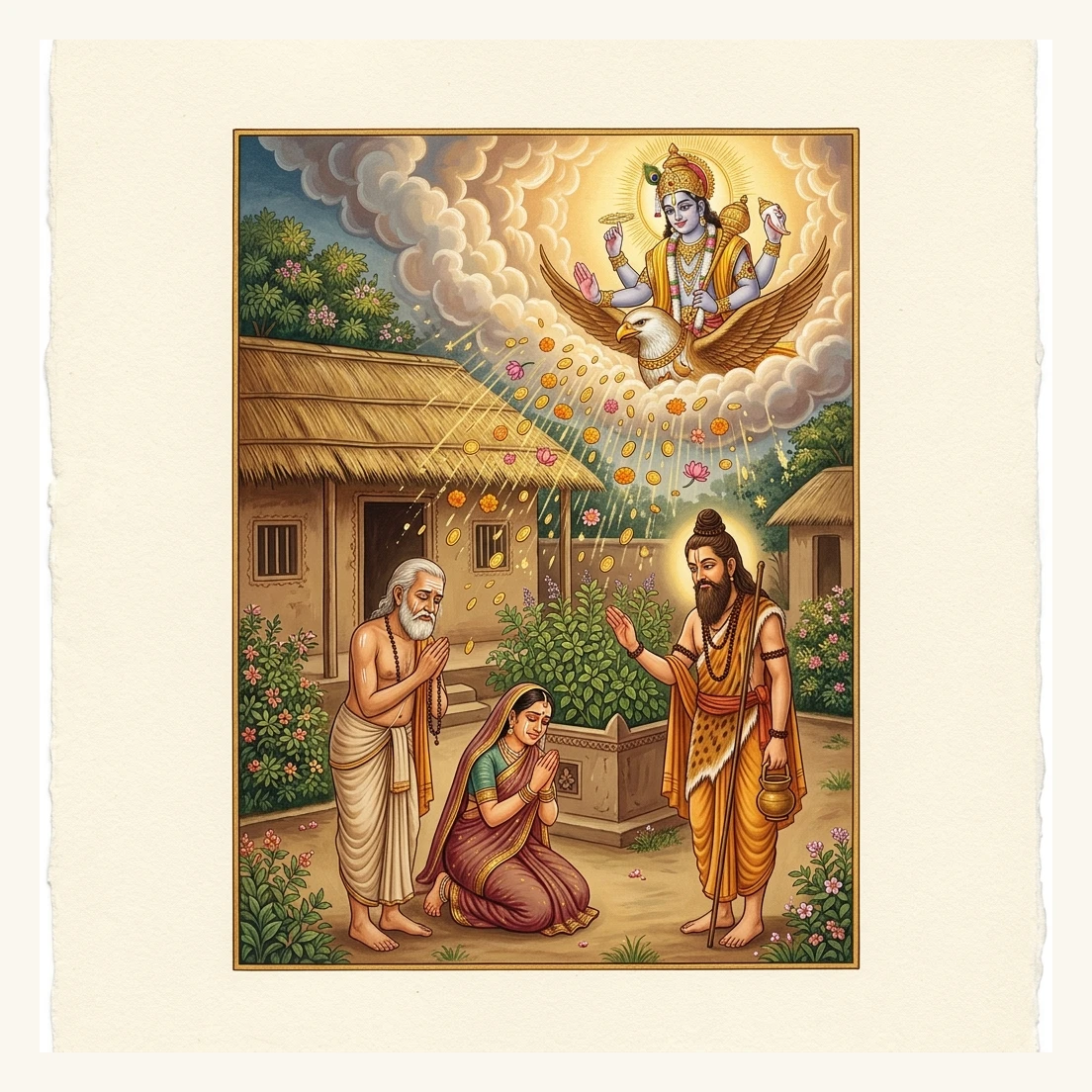
The poor brāhmaṇa and the prince at the door
Retold from the Skanda Purāṇa, narrated as a conversation between Kṛṣṇa and Yudhiṣṭhira.
This Ekādaśī is the second of the pair that belongs to the leap month. It falls in the dark fortnight of the adhika māsa — Puruṣottama Māsa — and like its sister Padminī, it appears only once every thirty-two to thirty-three months. The two together are the highest points of the highest month.
Yudhiṣṭhira had asked Kṛṣṇa about the Ekādaśī in the bright half of the leap month, and Kṛṣṇa had told him the story of Padminī and Kārtavīrya. Now Yudhiṣṭhira asked again. Oh Supreme Lord, what is the name of that Ekādaśī that occurs during the dark fortnight of the extra leap-year month of Puruṣottama? What is the process for observing it? Kindly narrate all of this to me.
Kṛṣṇa answered.
This meritorious day is called Paramā Ekādaśī. It bestows the great benediction of an enjoyable life and release from birth and death. The process for observing it is similar to that for observing the Ekādaśī of the bright half. Now let me tell you a wonderful story I heard from the great sage in the city of Kāmpilya.
The story is about a poor brāhmaṇa.
In Kāmpilya there lived a pious brāhmaṇa named Sumedha. His wife was Pavitra — the pure one — devoted to her husband. They had no money. They had no food. They had no clothing. They had no shelter to speak of. Sumedha begged for alms from house to house and received almost nothing. The Purāṇa attributes the poverty to a sin Sumedha had committed in a previous life — something he could not remember, but whose consequences he was now living.
The Purāṇa says something gentle about Pavitra. Despite their poverty, she served Sumedha faithfully. When guests came — and guests were unavoidable, since the dharma of householders is to feed those who arrive at the door — Pavitra would give them her own portion. She went hungry herself to feed strangers. She never asked her husband for anything. She made do with whatever they had.
One day Sumedha, exhausted, said to her: I have begged from the rich and receive hardly anything. Please permit me to go abroad and attain some wealth.
Pavitra answered him with a clarity that is worth quoting in its full reasoning.
One who, though in misery, is interested in the welfare of others speaks just as you have. However, the scriptures state that whatever wealth a person attains in his life is due to his having given charity in previous lives. If one has not given charity, then even though he may sit atop a mound of gold, he will still remain poor. Please, therefore, stay with me. Be satisfied with whatever wealth we get.
The teaching she offered was severe but kind: wealth is the karma of previous generosity. To go abroad seeking it without having earned it in past births was to chase what was not there to catch. Better to stay home and accept the situation.
Sumedha accepted her counsel. He stayed.
One day the great sage Kauṇḍinya arrived at their door. (This is the same Kauṇḍinya we have already met in Chapter 49 of the Padma Purāṇa, who absolved the fallen Dhṛṣṭabuddhi from the sin of his prostitutes and his hunt.) Sumedha and Pavitra prostrated. They had almost nothing to offer, but they offered what they could. They fed the sage with whatever was in the house.
After he had eaten, Pavitra asked the question.
Oh most learned one, what process can we follow to be relieved of our poverty?
Kauṇḍinya reflected. Then he gave the answer.
There is a fast day very dear to Lord Hari. Fasting on this day nullifies all kinds of sins and removes all miseries caused by poverty. This fast day, which occurs during the dark fortnight of the extra leap-year month, is known as Paramā Ekādaśī. It is the topmost day of Lord Viṣṇu — hence the name paramā, the supreme.
The sage gave them examples of who had observed it before.
This holy fast was once observed by Lord Kubera. When Lord Śiva saw how strictly he had fasted, he became pleased and made Kubera the treasurer of heaven. And king Hariścandra fasted on this Ekādaśī after his dear wife and son had been sold to a chāṇḍāla — and the king was able to get them back.
Kauṇḍinya was reminding them of the breadth of the vow. Hariścandra, who had also benefited from this vow (and whose other relief came through the Ajā Ekādaśī of Chapter 56), was the same Hariścandra whose daughter Padminī had observed the Padminī Ekādaśī of the bright fortnight. The two Ekādaśīs of the leap month had touched the same lineage at two different generations.
The sage gave Sumedha a further instruction. On the Dvādaśī — the day after Ekādaśī — you should vow to observe the Pancharātrika fast according to all the rules. After taking a bath early in the morning, you and your wife, along with both your parents and hers, should fast for five days according to your ability. Then you will all become eligible to return home, to the abode of Lord Viṣṇu.
The Pancharātrika fast — pañca-rātri, five nights — is the five-day observance that surrounds the two Ekādaśīs of the leap month. Begun on Daśamī and extended through Dvādaśī, it is the longer-form vow that the leap month makes possible.
Sumedha and Pavitra did what the sage instructed.
The Purāṇa is unusually specific about what happened next. After the observance, they saw a handsome prince approaching them from the royal palace. The prince gave them — gave, not loaned — a beautiful house. He also gave them an entire village for their livelihood.
The poverty of many years lifted in a single arrival.
Kṛṣṇa, telling this story to Yudhiṣṭhira, summarises: One who fasts on this day has also completed the offerings of oblations to his forefathers at Gayā. He has, in effect, fasted on all other auspicious days.
The Pancharātrika fast — the fast of five days in the extra leap-year month — is said to remove all kinds of abominable sins. But the Pancharātrika fast, together with the fasts of Paramā and Padminī Ekādaśī, destroys all of a person's sins.
The chapter ends with what reads almost as a benediction.
If a person is unable to fast on these days, he should observe the fasts during the extra month according to his ability. The rare human birth is meant for accumulating merit and at last achieving liberating release from this material world.
The vow
Paramā Ekādaśī falls on the eleventh tithi of the dark fortnight of the adhika māsa, which occurs roughly once every thirty-two to thirty-three months.
The classical observance prescribes:
- Daśamī (10th day): Eat once, light sāttvika food. Sleep on the ground. Remain celibate.
- Ekādaśī (11th day): Complete fast — nirjala if possible, otherwise with permitted fruits, milk, and water for those who cannot. Keep awake at night with worship, chanting, and bhajans.
- Dvādaśī (12th day): Begin the Pancharātrika five-day fast, if observing in full. Otherwise, break the Ekādaśī fast in the proper pāraṇa window after worship of Viṣṇu and feeding of a brāhmaṇa.
The Pancharātrika fast — five days surrounding the Ekādaśī — is observed by those with the strength and circumstances for it. It is the longer arc that the leap month uniquely allows.
The deity worshipped is Viṣṇu in his Puruṣottama form — the Supreme Being, the name the lord himself gave to this month when he adopted it.
The phalaśruti
One who fasts on this day has completed the offerings of oblations to his forefathers at Gayā. Gayā is the most sacred site for piṇḍa-dāna — ancestral offerings — in the entire tradition. The Ekādaśī's merit is set as equivalent to making that pilgrimage and performing that offering. He has fasted on all other auspicious days, the chapter adds, completing the comparison.
The teaching at the heart of Paramā Ekādaśī is in the conversation between Pavitra and Sumedha at the beginning of the story, and in the prince who arrived at the end.
The teaching at the beginning was that poverty has a karmic structure — that what we have not given in past lives we cannot expect to find in this one. The teaching at the end was that the structure is not closed. A vow precisely observed on a specific day, with the right understanding, can interrupt the karmic chain. The prince at the door was the result of one fast properly kept.
The Skanda Purāṇa does not promise easy wealth. It promises that there is a way through what looks impassable, and the way is small — a fast day, a sage at the door, a chaste wife who tells the truth about how merit works. The vow opens what years of begging could not.
Source: Skanda Purāṇa. The narrative is preserved as a conversation between Kṛṣṇa and Yudhiṣṭhira, with the inner story heard by Kṛṣṇa from a sage in Kāmpilya. The Skanda Purāṇa is the largest of the eighteen Mahāpurāṇas (over 81,000 verses), with a full English translation by G. V. Tagare available in the Ancient Indian Tradition and Mythology series, vols. 49–71 (Motilal Banarsidass, Delhi). The full English translation is freely available at wisdomlib.org.
Frequently asked
- What is Paramā Ekadasi?
- Paramā Ekadasi is the ekādaśī tithi — the eleventh lunar day — of the waning fortnight (kṛṣṇa pakṣa) of Adhika Māsa. Its name means "the supreme". Like every Ekadasi, it is observed by fasting and remembrance of Lord Viṣṇu. The story and fruits (phalaśruti) of Paramā are recorded in Skanda Purāṇa.
- When is Paramā Ekadasi observed?
- Paramā Ekadasi falls on the ekādaśī tithi of the waning fortnight of Adhika Māsa (the Hindu lunar month). The exact Gregorian date varies each year because the lunar calendar drifts relative to the solar one. Smārta and Vaiṣṇava observers occasionally fast on different civil days when the tithi spans two sunrises — see the date above for the next occurrence.
- Who is worshipped on Paramā Ekadasi?
- Paramā Ekadasi, like all Ekadasis, is dedicated to Viṣṇu (as Puruṣottama). Specific forms of worship vary by tradition: chanting Viṣṇu-sahasranāma, reading the corresponding chapter from Skanda Purāṇa, hearing the story, and remembering the divine names are all considered part of the observance.
- What is the spiritual fruit (phalaśruti) of observing Paramā Ekadasi?
- The Purāṇic source declares that observing Paramā Ekadasi yields: An enjoyable life and release from birth and death; the Pancharātrika five-day fast destroys all sins; observed only in the leap month. Across all Ekadasis, the underlying claim is the same — the fast aligns the body, breath, and mind with the eleventh lunar day's particular quietness, and bestows merit equivalent to extensive austerities, charity, or pilgrimage.
- How is Paramā Ekadasi observed?
- A complete observance begins the previous evening with a light, sattvic meal and continues into a fast on Ekadasi day. The fast can be nirjala (without water), phalāhāra (fruits and water), or a single sattvic meal — pick the level your health and discipline allow. Grains, pulses, onions, and garlic are universally avoided on Ekadasi. The fast is broken on Dvādaśī during the prescribed pāraṇa window listed on this page. The day is spent in remembrance — chanting, reading, hearing the Ekadasi story, and avoiding sleep during daylight where possible.
- What is the difference between Smārta and Vaiṣṇava observance of Paramā Ekadasi?
- On most Ekadasis the two traditions fast on the same day. They diverge only in the rare atirikta case — when the Ekadasi tithi spans two consecutive sunrises. Smārtas fast on the first such day; Vaiṣṇavas wait until the next, preferring that Dvādaśī also touches sunrise. If Paramā Ekadasi falls in such a fortnight in a given year, the two dates will appear on this page side by side.
Found an error?
ekadasi.day has no ads and no popups. If a date, name, or story reads wrong, please write — accuracy matters more than reach.
feedback@ekadasi.day →·Other ways to help