Māgha · Kṛṣṇa Pakṣa

Shaṭṭilā Ekadasi

The six sesame

Next occurrence

Tuesday, January 13, 2026

Ekadasi tithi
Tue
13 Jan
4:48 AM
Dvādaśī begins
Wed
14 Jan
7:23 AM
Hari Vāsara ends
Wed
14 Jan
7:23 AM
Pāraṇa window
Wed
14 Jan
7:51 AM – 10:16 AM

The fasting woman whose heaven was empty

Retold from the Padma Purāṇa, Uttara Khaṇḍa, Chapter 42. The standard English translation, on which this retelling relies, is by N.A. Deshpande (Motilal Banarsidass).

The story of Ṣaṭtilā Ekādaśī is the story of a woman who did everything right and still received an empty house in heaven.

Kṛṣṇa tells it to Yudhiṣṭhira as a story the sage Pulastya once told to another sage named Dālabhya. Dālabhya had asked the question every observer of vows eventually asks: how does sin perish by means of some small gift? How does a person who has stolen wealth, killed a brāhmaṇa, or fallen to great addictions — how does such a person not go to hell? And on the other side of the same question: what about those who do everything by the book?

In the mortal world, Kṛṣṇa says, there once lived a brāhmaṇa woman. She was the kind of devotee one points to. She observed every vow. She kept every monthly fast. She was deeply devoted to Kṛṣṇa, observed his Ekādaśīs with care, and tormented her body with austerities. She gave away her possessions — her house, even — in devotion to gods, brāhmaṇas, and maidens. She took delight in great expiation.

But she did not give food.

She did not give alms to beggars at her door. She did not feed brāhmaṇas. The text is precise about what this missing piece was. She did not offer food, by means of which great satisfaction would be had.

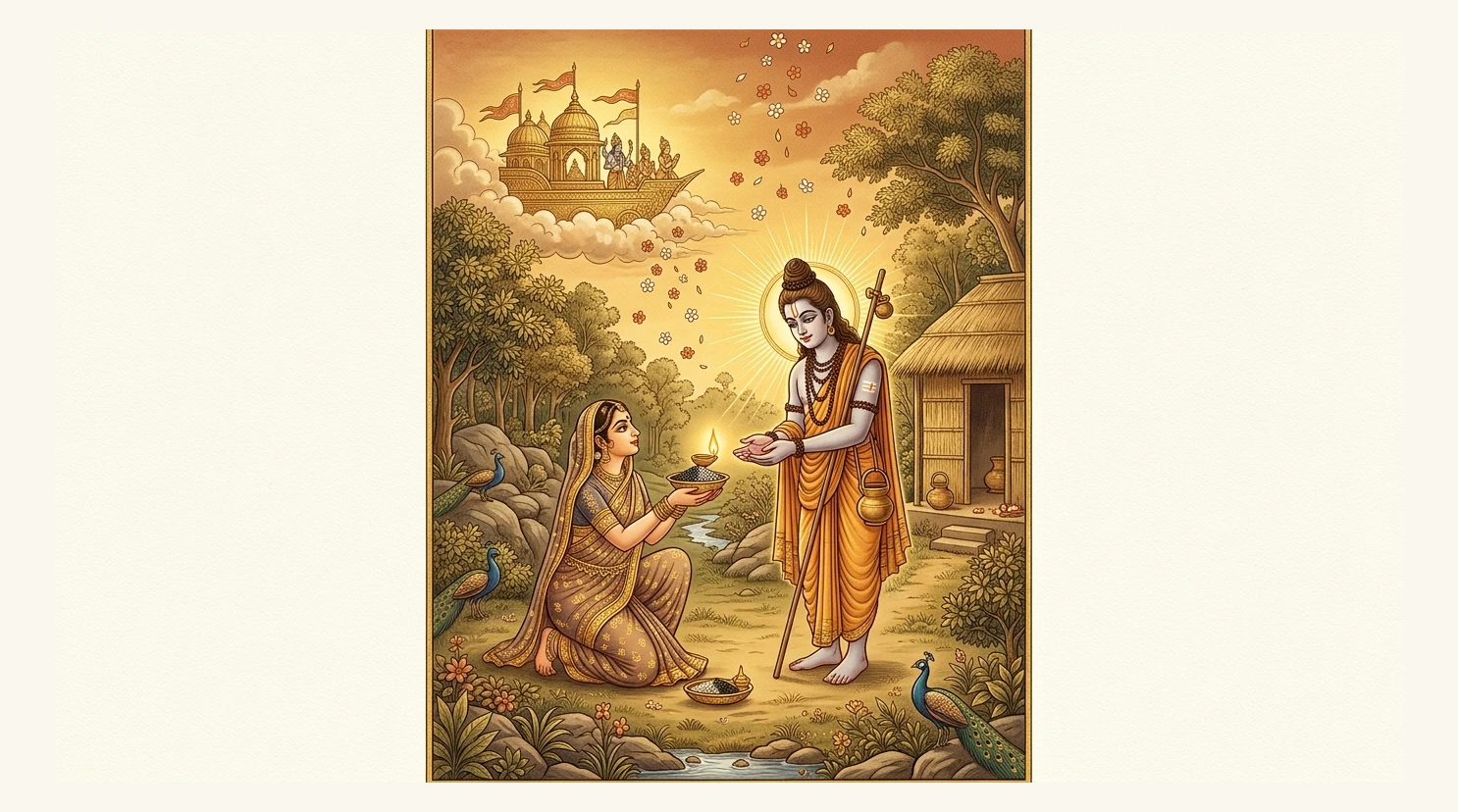
Kṛṣṇa watched her for a long time. Eventually he came down to the mortal world himself, dressed in the form of a Kāpāla — an ascetic of a Śaiva left-hand order who carried human skulls as a begging bowl. He stood at her door and asked for alms.

She looked at him with suspicion. What for have you come? she asked. Where will you go later?

He said again: O beautiful woman, give me alms.

With great wrath, she picked up a lump of clay from the ground and threw it into his copper begging-vessel.

Kṛṣṇa took the clay and returned to heaven.

In time, by the power of all her vows and fasts, the woman herself ascended bodily to heaven, as the texts say accomplished ascetics do. There was a house prepared for her there — a charming one. She entered it.

It was empty.

There was no grain in it. There was no furniture. There was no provision. She walked through its lovely rooms and found nothing she could eat, nothing she could use, nothing that could sustain a life inside it.

She came to Kṛṣṇa in fury. By many kinds of vows, expiations, and fasts, with worship, I propitiated you, the guardian of the entire world. O Janārdana, nothing is seen there in my house.

Kṛṣṇa heard her out. Then he said: Go home. Wives of gods, full of great curiosity and wonder, will come to see you. Do not open the door unless they recite the auspicious account of Ṣaṭtilā.

She went back. The goddesses came, as he had said they would. We have come to see you. O beautiful woman, open the door so that we shall see you.

The woman, who had observed every vow she had ever heard of, said: If you want to see me, you must tell the truth — the meritorious vow of Ṣaṭtilā — for opening the door.

The goddesses hesitated. None of them had told her. They had assumed she knew everything. Finally one of them, perhaps the kindest, gave her the vow.

When the woman, her vow newly learned, observed the Ṣaṭtilā Ekādaśī properly — when she finally added to her austerities the practice of giving, especially the giving of sesame — her house filled. Wealth came. Grain came. Garments and gold and silver appeared. In a moment she was endowed with beauty and loveliness. Her house was endowed with everything.

The lesson of Ṣaṭtilā is in its name. Ṣaṭ means six. Tila means sesame seed. The Ekādaśī gets its name from six uses of sesame, all of which the chapter prescribes — and which together amount to a daylong meditation on giving and being given to:

  1. Bathing in water mixed with sesame seeds
  2. Rubbing one's body with sesame
  3. Offering sesame in a sacrifice
  4. Offering water mixed with sesame (the tarpaṇa for ancestors)
  5. Giving sesame as a gift
  6. Eating sesame

The first two purify the body. The next two are offerings — to gods, to the dead. The fifth is the practice the brāhmaṇa woman had refused. The sixth is the one that takes what was given back into oneself.

The vow

Ṣaṭtilā Ekādaśī is observed on the eleventh tithi of the dark fortnight of Māgha. The fast is broken on Dvādaśī.

The preparation is specific. From cow-dung mixed with sesame and cotton, the observer fashions one hundred and eight small balls. The fast is kept on Ekādaśī with the names of Kṛṣṇa recited through the day and the night kept awake. On Dvādaśī, Viṣṇu is worshipped a second time, with sandal, agaru, camphor, eatables, rice and peas with spices. Pumpkin gourds, coconuts, and citrons are offered; in their absence, betel nuts. A dark cow is given to a brāhmaṇa according to the observer's capacity, and especially: a pot full of black sesame seeds.

The hymn for the offering: O Kṛṣṇa, Kṛṣṇa, you are kind. Be the refuge of those who have no refuge. O Viṣṇu, favour those who are plunged in the ocean of mundane existence.

The phalaśruti

For as many thousands of years as there are sprouts from the sesame seeds in the field, the chapter says, the giver is honoured in heaven.

The observer is granted good health in every existence. They will not see poverty, or misery, or misfortune. Sin is destroyed without effort.

But the deeper teaching is the one the brāhmaṇa woman learned in her empty house. Austerity alone is not enough. The body purified by fasting is half the work. The other half is what the body, once purified, gives away. The Purāṇa is saying something quietly radical: all your fasts will give you only an empty heaven if you have not learned to feed someone hungrier than yourself.

Source: Padma Purāṇa, Uttara Khaṇḍa, Chapter 42, "The Vow of Ṣaṭtilā Ekādaśī." Translated by N.A. Deshpande in Ancient Indian Tradition and Mythology series, vols. 39–48 (Motilal Banarsidass, Delhi, ISBN 9788120838291). The full English translation is freely available at wisdomlib.org.

Frequently asked

What is Shaṭṭilā Ekadasi?
Shaṭṭilā Ekadasi is the ekādaśī tithi — the eleventh lunar day — of the waning fortnight (kṛṣṇa pakṣa) of Māgha. Its name means "the six sesame". Like every Ekadasi, it is observed by fasting and remembrance of Lord Viṣṇu. The story and fruits (phalaśruti) of Shaṭṭilā are recorded in Padma Purāṇa, Uttara Khaṇḍa, Chapter 42.
When is Shaṭṭilā Ekadasi observed?
Shaṭṭilā Ekadasi falls on the ekādaśī tithi of the waning fortnight of Māgha (the Hindu lunar month). The exact Gregorian date varies each year because the lunar calendar drifts relative to the solar one. Smārta and Vaiṣṇava observers occasionally fast on different civil days when the tithi spans two sunrises — see the date above for the next occurrence.
Who is worshipped on Shaṭṭilā Ekadasi?
Shaṭṭilā Ekadasi, like all Ekadasis, is dedicated to Viṣṇu. Specific forms of worship vary by tradition: chanting Viṣṇu-sahasranāma, reading the corresponding chapter from Padma Purāṇa, Uttara Khaṇḍa, Chapter 42, hearing the story, and remembering the divine names are all considered part of the observance.
What is the spiritual fruit (phalaśruti) of observing Shaṭṭilā Ekadasi?
The Purāṇic source declares that observing Shaṭṭilā Ekadasi yields: Good health in every existence; no poverty, misery, or misfortune; freedom from all sins by the gift of sesame. Across all Ekadasis, the underlying claim is the same — the fast aligns the body, breath, and mind with the eleventh lunar day's particular quietness, and bestows merit equivalent to extensive austerities, charity, or pilgrimage.
How is Shaṭṭilā Ekadasi observed?
A complete observance begins the previous evening with a light, sattvic meal and continues into a fast on Ekadasi day. The fast can be nirjala (without water), phalāhāra (fruits and water), or a single sattvic meal — pick the level your health and discipline allow. Grains, pulses, onions, and garlic are universally avoided on Ekadasi. The fast is broken on Dvādaśī during the prescribed pāraṇa window listed on this page. The day is spent in remembrance — chanting, reading, hearing the Ekadasi story, and avoiding sleep during daylight where possible.
What is the difference between Smārta and Vaiṣṇava observance of Shaṭṭilā Ekadasi?
On most Ekadasis the two traditions fast on the same day. They diverge only in the rare atirikta case — when the Ekadasi tithi spans two consecutive sunrises. Smārtas fast on the first such day; Vaiṣṇavas wait until the next, preferring that Dvādaśī also touches sunrise. If Shaṭṭilā Ekadasi falls in such a fortnight in a given year, the two dates will appear on this page side by side.

Found an error?

ekadasi.day has no ads and no popups. If a date, name, or story reads wrong, please write — accuracy matters more than reach.

feedback@ekadasi.day →·Other ways to help
Ṣaṭtilā Ekādaśī · ekadasi.day