Śrāvaṇa · Śukla Pakṣa

Putradā Ekadasi (Śrāvaṇa)

The giver of progeny

Next observedThursday, 30 July 2020

Next occurrence

Thursday, July 30, 2020

Ekadasi tithi
Wed
29 Jul
3:46 PM
Dvādaśī begins
Thu
30 Jul
2:20 PM
Hari Vāsara ends
Thu
30 Jul
2:20 PM
Pāraṇa window
Fri
31 Jul
6:29 AM – 10:03 AM

The king saved by his subjects

Retold from the Padma Purāṇa, Uttara Khaṇḍa, Chapter 55. The standard English translation, on which this retelling relies, is by N.A. Deshpande (Motilal Banarsidass).

There are two Putradā Ekādaśīs in the year — one in Pauṣa (Chapter 41, the story of King Suketumat) and this one in Śrāvaṇa. They share a name and a fruit. The names are not coincidence; the texts treat them as a pair, both vows for the granting of children. But the Śrāvaṇa version contains a different teaching, one that is rare in the Purāṇic literature: this time, it is the subjects who save the king.

The chapter begins at the start of the Dvāpara age. In the city of Māhiṣmatī ruled a king named Mahījit. He was a good king. He examined his life and found nothing wanting in it. But he had no son.

The Purāṇa lets him speak for himself, in an unusual extended self-defence. Mahījit summoned his subjects and his court and stood before them.

O people, he said, in this life I have not committed a sin. I have not put into my treasury money that is unjustly earned. I have never taken away a brāhmaṇa's wealth, nor the wealth of a deity. I have never taken away another's deposit, which causes great sin. I have looked after the people like my own sons. I have conquered the land righteously. I have inflicted punishment on the wicked, even though they were like my brother or son. The eminent persons were always honoured by me. I have not hated people.

He had run through the checklist of a righteous king. He could not find what was missing.

O best brāhmaṇas, think over as to why a son is not born in the house of me who am thus talking about a righteous path.

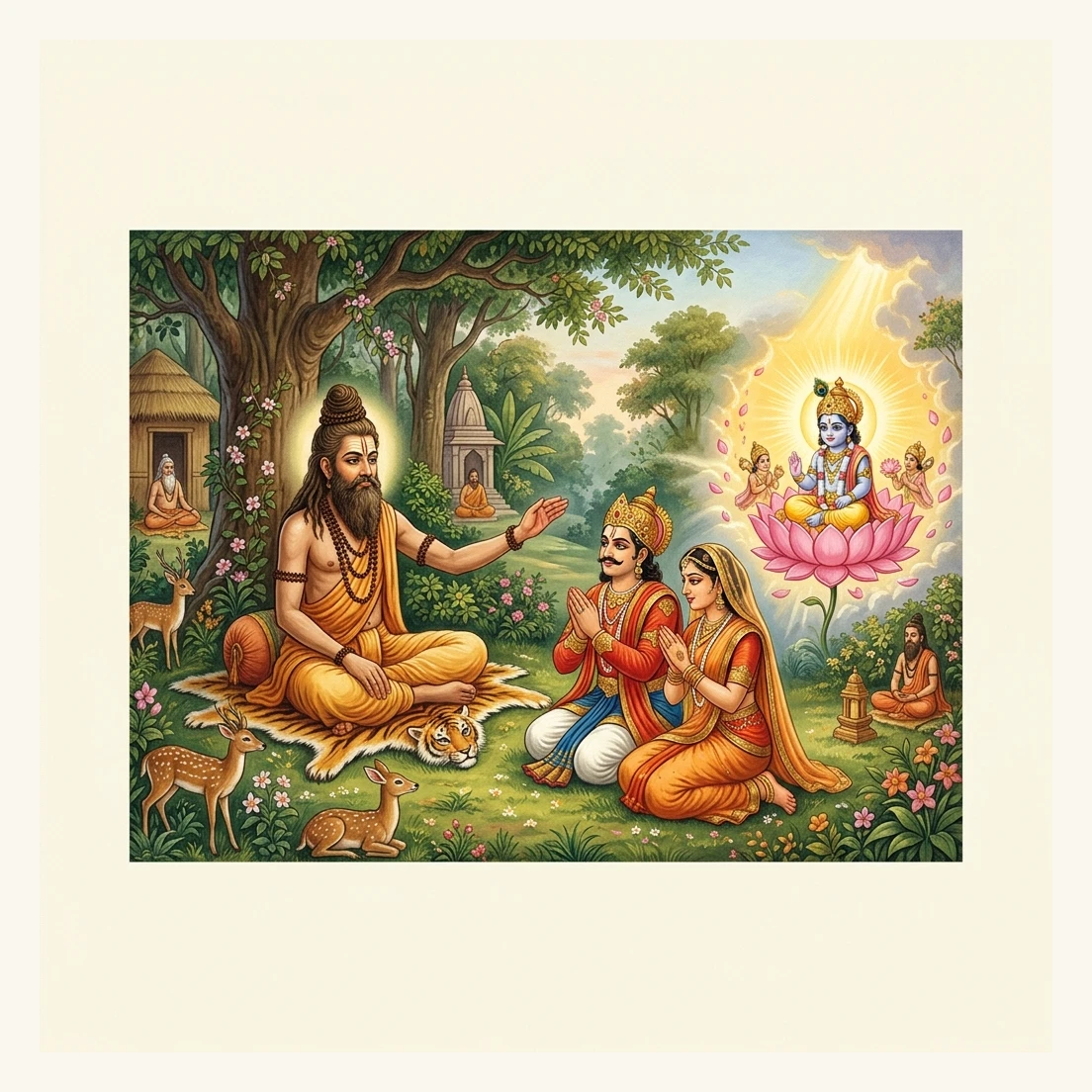
The brāhmaṇas, along with the subjects and the family-priest, took the question seriously. They did not pretend to know the answer. They held council. Then they went out together — the whole consultative body of the kingdom — into a dense forest in search of a sage who might know.

They came eventually to a hermitage so ancient that everything in it appeared still. There sat a sage all alone, practising a severe penance. He was ancient. He did not eat food. He had conquered his soul. He had controlled his anger. He knew the truth about righteousness. He was proficient in all sacred texts. His life had been long; he resembled Brahmā.

The Purāṇa pauses on the detail that gave him his name. He had hair. But: as each kalpa passed, one of his hairs withered. A kalpa is a day of Brahmā — roughly 4.32 billion years. The sage had been alive long enough that an entire kalpa had aged him by exactly one hair.

His name was Lomaśa — the hairy one, the one named for his hair, the one whose age was measured in the count of his remaining hairs. He was omniscient because of how much he had seen.

The delegation saluted him. Due to our good fortune only, we have come across this best sage.

Lomaśa, kind as long-lived sages tend to be, asked: Why have you come here? Tell me, with the reason. I shall certainly do what would be beneficial to you. The existence of people like me is for obliging others.

The subjects spoke for their king. We have come to you to get our doubt removed. There is none greater than Brahmā except you. King Mahījit is sonless. We are his subjects, looked after by him like his own sons. Seeing him sonless and distressed by his grief, we have come here to practise penance. Give instruction as to how the king would have a son.

Lomaśa sat in meditation for a moment. He looked into the king's previous birth.

He came back with the answer.

In the previous existence, Lomaśa said, Mahījit was a poor vaiśya, engaged in trade. He roamed from village to village, doing evil deeds. On the tenth day in the bright half of Jyeṣṭha, when the Sun had reached the centre of the sky, he was on the border of a village. He saw a pond. He decided to drink water from it.

Just then a cow with her calf arrived. Oppressed by thirst and heat, she went to the same water and began to drink.

He prevented her from drinking, and himself drank first.

Due to that sinful act, the king became sonless. By the religious merit of some other existence he obtained this present kingdom free from trouble. But the act of denying water to a thirsty cow has followed him through births.

The subjects asked the next question. It is heard from the Purāṇas that sin perishes due to religious merit. Advise about the religious merit by which the king would have a son.

Lomaśa gave them the answer. Observe the Ekādaśī which falls in the bright half of Śrāvaṇa, called Putradā. It gives desired objects.

The subjects went home. They observed the vow themselves. They fasted, kept awake, performed the vow correctly. Then they gave the merit — its very pure religious merit, the text says — to the king.

The queen conceived. When the time of delivery arrived, a bright son was born. He became, in due course, a king.

The vow

Putradā Ekādaśī in Śrāvaṇa falls on the eleventh tithi of the bright fortnight of Śrāvaṇa. The fast is broken on Dvādaśī. The observance is the standard one.

This Ekādaśī, like its sister in Pauṣa, is observed by those seeking children — parents, parents-in-waiting, parents seeking the birth of a son. But the story attached to this version contains a different element. The vow's merit can be transferred not only between family members (as in Mokṣadā or Kāmadā) but from a community to its leader. A whole society's collective devotion can lift one person.

This is the Ekādaśī for petitions where the petitioner cannot make the merit themselves — a child for an ailing couple, healing for someone in a coma, the rebirth of a deceased relative. The chapter is saying that the merit-transfer mechanism is real, that it works community-to-individual, and that subjects can give their king what he cannot give himself.

The phalaśruti

Reciting or listening to the account gives the fruit of a Vājapeya sacrifice — the imperial Vedic rite.

The deeper teaching of this Ekādaśī, hidden in Lomaśa's diagnosis, is the long memory of small cruelties. Mahījit's failure to have a son was not caused by any sin in this life. It was caused by a single thirsty cow, denied water at a pond by a poor vaiśya in a former birth. The Purāṇa is suggesting something the rest of us would do well to remember: there is no minor unkindness. The thirsty creature you turned away from a well, in a body you no longer remember, may be sitting in your present life as the absence of the thing you most want. And it can be undone — but only by an act of generosity equally specific. In Mahījit's case, by his whole kingdom observing a vow on his behalf.

Source: Padma Purāṇa, Uttara Khaṇḍa, Chapter 55, "Putradā Ekādaśī." Translated by N.A. Deshpande in Ancient Indian Tradition and Mythology series, vols. 39–48 (Motilal Banarsidass, Delhi, ISBN 9788120838291). The full English translation is freely available at wisdomlib.org.

Frequently asked

What is Putradā Ekadasi?
Putradā Ekadasi is the ekādaśī tithi — the eleventh lunar day — of the waxing fortnight (śukla pakṣa) of Śrāvaṇa. Its name means "the giver of progeny". Like every Ekadasi, it is observed by fasting and remembrance of Lord Viṣṇu. The story and fruits (phalaśruti) of Putradā are recorded in Padma Purāṇa, Uttara Khaṇḍa, Chapter 55.
When is Putradā Ekadasi observed?
Putradā Ekadasi falls on the ekādaśī tithi of the waxing fortnight of Śrāvaṇa (the Hindu lunar month). The exact Gregorian date varies each year because the lunar calendar drifts relative to the solar one. Smārta and Vaiṣṇava observers occasionally fast on different civil days when the tithi spans two sunrises — see the date above for the next occurrence.
Who is worshipped on Putradā Ekadasi?
Putradā Ekadasi, like all Ekadasis, is dedicated to Viṣṇu. Specific forms of worship vary by tradition: chanting Viṣṇu-sahasranāma, reading the corresponding chapter from Padma Purāṇa, Uttara Khaṇḍa, Chapter 55, hearing the story, and remembering the divine names are all considered part of the observance.
What is the spiritual fruit (phalaśruti) of observing Putradā Ekadasi?
The Purāṇic source declares that observing Putradā Ekadasi yields: The fruit of a Vājapeya sacrifice; subjects can transfer their merit to the king for the birth of a son. Across all Ekadasis, the underlying claim is the same — the fast aligns the body, breath, and mind with the eleventh lunar day's particular quietness, and bestows merit equivalent to extensive austerities, charity, or pilgrimage.
How is Putradā Ekadasi observed?
A complete observance begins the previous evening with a light, sattvic meal and continues into a fast on Ekadasi day. The fast can be nirjala (without water), phalāhāra (fruits and water), or a single sattvic meal — pick the level your health and discipline allow. Grains, pulses, onions, and garlic are universally avoided on Ekadasi. The fast is broken on Dvādaśī during the prescribed pāraṇa window listed on this page. The day is spent in remembrance — chanting, reading, hearing the Ekadasi story, and avoiding sleep during daylight where possible.
What is the difference between Smārta and Vaiṣṇava observance of Putradā Ekadasi?
On most Ekadasis the two traditions fast on the same day. They diverge only in the rare atirikta case — when the Ekadasi tithi spans two consecutive sunrises. Smārtas fast on the first such day; Vaiṣṇavas wait until the next, preferring that Dvādaśī also touches sunrise. If Putradā Ekadasi falls in such a fortnight in a given year, the two dates will appear on this page side by side.

Found an error?

ekadasi.day has no ads and no popups. If a date, name, or story reads wrong, please write — accuracy matters more than reach.

feedback@ekadasi.day →·Other ways to help
Putradā Ekādaśī (Śrāvaṇa) · ekadasi.day