Āśvina · Kṛṣṇa Pakṣa
Indirā Ekadasi
For the ancestors
Next observedSunday, 13 September 2020
Next occurrence
Sunday, September 13, 2020
- Ekadasi tithi
- Sat
- 12 Sep
- 6:44 PM
- Dvādaśī begins
- Sun
- 13 Sep
- 5:46 PM
- Hari Vāsara ends
- Sun
- 13 Sep
- 5:46 PM
- Pāraṇa window
- Mon
- 14 Sep
- 7:12 AM – 10:19 AM
The message from Yama's world
Retold from the Padma Purāṇa, Uttara Khaṇḍa, Chapter 58. The standard English translation, on which this retelling relies, is by N.A. Deshpande (Motilal Banarsidass).
In Kṛta-yuga there ruled in the city of Māhiṣmatī a prince named Indrasena. He was righteous. He had sons and grandsons. He had wealth and grain. He was, the Purāṇa says, solely devoted to Viṣṇu. He repeated Viṣṇu's names internally as he passed his days. He meditated on the Supreme Spirit. He was the kind of devotee for whom the cycle of duty and prayer had become natural.
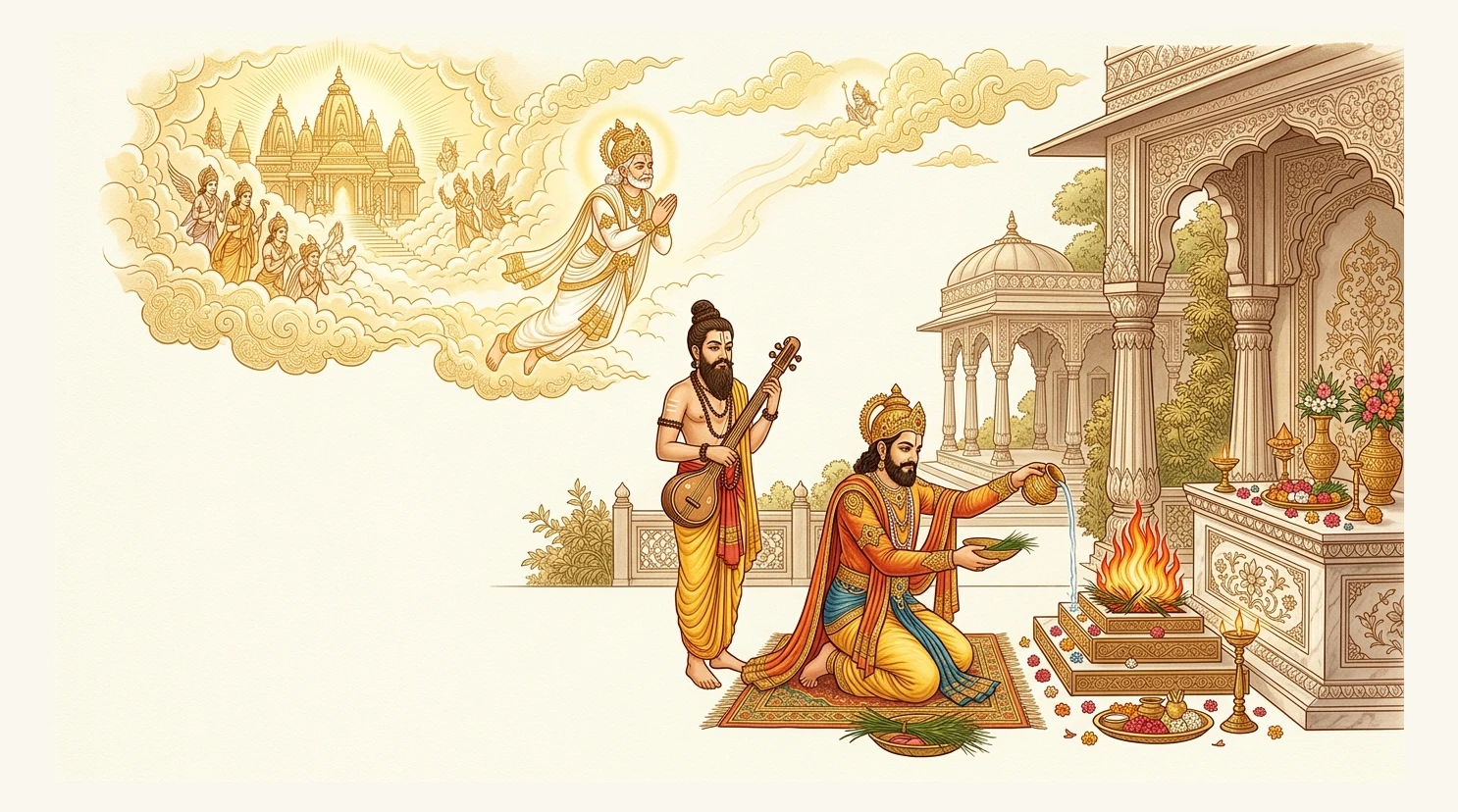
One day, while he was seated comfortably in his assembly, the sage Nārada descended from the sky.
The king received him with all the courtesies due. He stood, palms folded, offered a seat, ensured the sage was comfortable. Then he asked the standard question: O best sage, by your grace everything of me is prosperous. By seeing you, all my sacrifices and rites have become fruitful. Favour me and tell me the reason of your arrival.
Nārada answered.
O best king, listen to my wonderful words. From Brahmā's world I had gone to the world of Yama. Yama, the religious son of the Sun, honoured me. I sat on an excellent seat in his assembly.
The king listened. The sage had been to the world of the dead.
In the assembly of the deity of Śrāddhas — the assembly, that is, where ancestral offerings are received and judged — I saw your father.
The king's father, the previous king of Māhiṣmatī, was in Yama's world.
A doer of many righteous acts, Nārada said, with care, there as a result of a fault in a vow.
Some small flaw in his observance of a previous vow had landed him in the ancestral court of Yama instead of in Vishnu's heaven. The Purāṇa is precise about this. The father was not in hell. He was not being tortured. But he was stuck — staying with Yama due to some hindrance from his former existence, his progress to a higher world prevented by an unfinished business.
He had a message for his son.
Tell him, the father had said, through Nārada, that I am staying with Yama due to some hindrance, due to my former existence. O son, giving me the religious merit of the Indirā vow, send me to heaven.
The father knew the vow. The father, in Yama's world, could see what would lift him. He could not perform it himself — vows are for the living. But a son in the living world, the son who still had a body and could fast and keep awake and worship, could do what he could not.
The father had asked his son for help.
Nārada said: For the attainment of heaven by your father, observe the Indirā vow. By the power of that vow your father will go to heaven.
The king did not hesitate. Favour me, he said, and tell me about the Indirā vow. In what manner is it to be done? In which fortnight, and on which date?
Nārada gave the instructions in unusual detail.
The vow
The chapter prescribes the Indirā observance step by step, and the steps deserve to be set out as the text gives them.
On the tenth day (Daśamī) in the dark half of Āśvina, the observer should bathe in the morning. He should bathe again at midday. He should be composed. He should perform the Śrāddha — the offering to ancestors — with faith, to gratify his manes. Then he should eat only once that day. He should sleep on the ground at night.
On the eleventh day (Ekādaśī), at the bright morning's dawn, he should wash his face without cleaning his teeth. (This unusual instruction sets the day apart — tooth-cleaning is normally a daily duty, but on this day it is suspended, perhaps because the day's offerings are themselves the purification.) He should devoutly take up the vow of fasting. The mantra is given: Remaining without food and without all pleasures today, I shall eat tomorrow, O lotus-eyed one. O Viṣṇu, be my refuge.
At midday, he should bathe the tip of the Śālagrāma stone — that is, ritually bathe a small black ammonite stone, which is held to be Viṣṇu himself in mineral form. He should worship Viṣṇu with incense, sandal, lamps, and offerings. At night, he should keep awake near Viṣṇu.
On the twelfth day (Dvādaśī), in the morning, after worshipping Viṣṇu, he should again perform the Śrāddha — the second offering to ancestors. The chapter lists the foods that make a pure Śrāddha offering: wheat flour, barley, rice, sesamum seeds, beans, grams. He should honour brāhmaṇas with gifts and worship them. Then, in controlled speech, he should eat with his kinsmen, his daughter's son, and his sons.
The vow is observed with the ancestors — first by feeding them the previous day, then by fasting in their name, then by feeding them again the next day. The fast on Indirā sits between two offerings to the dead.
Indrasena observed it precisely. His father, by the power of the vow, was released from Yama's world and went to Viṣṇu's heaven.
The phalaśruti
The chapter says simply: the observer's dead ancestors will go to Viṣṇu's world. Reciting or listening to the account gives the fruit of a Vājapeya sacrifice.
The deeper teaching of Indirā lies in when it falls. Indirā Ekādaśī sits inside Pitṛ Pakṣa — the fortnight (the dark half of Āśvina) traditionally devoted entirely to offerings to ancestors. For sixteen days, observant households offer water and food to those who have passed. Indirā Ekādaśī is the most powerful of these days. It is the one day in the year when a son can, by a single act of devotion, lift an ancestor out of an in-between place.
The Purāṇa is acknowledging, in this chapter, something gentle and important. The dead are not always where we hope they are. A father who lived a good life may still be detained — by some imperfect vow, some unfinished business, some debt of attention that fell short. The Indirā vow is the way to complete what they could not. The son, having received a body and a life from his father, returns the gift in this form: he fasts on the day the father needs him to fast, and the merit travels.
Source: Padma Purāṇa, Uttara Khaṇḍa, Chapter 58, "Indirā Ekādaśī." Translated by N.A. Deshpande in Ancient Indian Tradition and Mythology series, vols. 39–48 (Motilal Banarsidass, Delhi, ISBN 9788120838291). The full English translation is freely available at wisdomlib.org.
Frequently asked
- What is Indirā Ekadasi?
- Indirā Ekadasi is the ekādaśī tithi — the eleventh lunar day — of the waning fortnight (kṛṣṇa pakṣa) of Āśvina. Its name means "for the ancestors". Like every Ekadasi, it is observed by fasting and remembrance of Lord Viṣṇu. The story and fruits (phalaśruti) of Indirā are recorded in Padma Purāṇa, Uttara Khaṇḍa, Chapter 58.
- When is Indirā Ekadasi observed?
- Indirā Ekadasi falls on the ekādaśī tithi of the waning fortnight of Āśvina (the Hindu lunar month). The exact Gregorian date varies each year because the lunar calendar drifts relative to the solar one. Smārta and Vaiṣṇava observers occasionally fast on different civil days when the tithi spans two sunrises — see the date above for the next occurrence.
- Who is worshipped on Indirā Ekadasi?
- Indirā Ekadasi, like all Ekadasis, is dedicated to Viṣṇu. Specific forms of worship vary by tradition: chanting Viṣṇu-sahasranāma, reading the corresponding chapter from Padma Purāṇa, Uttara Khaṇḍa, Chapter 58, hearing the story, and remembering the divine names are all considered part of the observance.
- What is the spiritual fruit (phalaśruti) of observing Indirā Ekadasi?
- The Purāṇic source declares that observing Indirā Ekadasi yields: The fruit of a Vājapeya sacrifice; ancestors who have fallen are sent to Viṣṇu's world. Across all Ekadasis, the underlying claim is the same — the fast aligns the body, breath, and mind with the eleventh lunar day's particular quietness, and bestows merit equivalent to extensive austerities, charity, or pilgrimage.
- How is Indirā Ekadasi observed?
- A complete observance begins the previous evening with a light, sattvic meal and continues into a fast on Ekadasi day. The fast can be nirjala (without water), phalāhāra (fruits and water), or a single sattvic meal — pick the level your health and discipline allow. Grains, pulses, onions, and garlic are universally avoided on Ekadasi. The fast is broken on Dvādaśī during the prescribed pāraṇa window listed on this page. The day is spent in remembrance — chanting, reading, hearing the Ekadasi story, and avoiding sleep during daylight where possible.
- What is the difference between Smārta and Vaiṣṇava observance of Indirā Ekadasi?
- On most Ekadasis the two traditions fast on the same day. They diverge only in the rare atirikta case — when the Ekadasi tithi spans two consecutive sunrises. Smārtas fast on the first such day; Vaiṣṇavas wait until the next, preferring that Dvādaśī also touches sunrise. If Indirā Ekadasi falls in such a fortnight in a given year, the two dates will appear on this page side by side.
Found an error?
ekadasi.day has no ads and no popups. If a date, name, or story reads wrong, please write — accuracy matters more than reach.
feedback@ekadasi.day →·Other ways to help