Adhika Māsa · Śukla Pakṣa
Padminī Ekadasi
The lotus-named, of the leap month
Next observedSunday, 27 September 2020
Next occurrence
Sunday, September 27, 2020
- Ekadasi tithi
- Sat
- 26 Sep
- 9:30 AM
- Dvādaśī begins
- Sun
- 27 Sep
- 10:16 AM
- Hari Vāsara ends
- Sun
- 27 Sep
- 10:16 AM
- Pāraṇa window
- Mon
- 28 Sep
- 7:25 AM – 10:23 AM
The queen whose ten thousand years asked for a son
Retold from the Skanda Purāṇa, with parallel references in the Padma Purāṇa and the Bhaviṣyottara Purāṇa. The story is set as a conversation between Kṛṣṇa and Yudhiṣṭhira, with the inner tale narrated by the sage Pulastya to Nārada.
This Ekādaśī does not fall every year.
The Hindu lunar year of twelve months is shorter than the solar year, and every thirty-two to thirty-three months an adhika māsa — an extra month — is inserted to bring them back into agreement. The month belongs to no fixed season. It belongs to no zodiac. Because it is unattached to either the lunar months above it or the solar reckoning beneath, it was considered, in the older tradition, slightly inauspicious — a mala māsa, a tainted month, in which weddings and major rituals were not begun.
Then, the tradition says, Viṣṇu himself adopted it.
He claimed the orphan month as his own and renamed it. He called it Puruṣottama Māsa — the month of the Supreme Being. He declared that whoever observed devotions in this month, however poor or however busy, would receive merit beyond what the twelve regular months could give. And he placed within it two Ekādaśīs — Padminī in the bright fortnight, Paramā in the dark — to be the highest points of the highest month.
The story Pulastya told Nārada concerns the first observer.
In the Tretā yuga, in the city of Māhiṣmatī, ruled a king named Kṛtavīrya — or, in some recensions, Kārtavīrya the elder, of the Haihaya lineage. He had a thousand queens. The Purāṇa does not blush at the number — kings in those ages kept large households for reasons political and dynastic, and the question for the king was not how many wives he had but whether any of them could give him an heir.
None of them could.
Kṛtavīrya performed sacrifices. He worshipped the gods. He honoured his ancestors. He consulted physicians, sages, and teachers. He did all the things a wealthy king with a problem could do, and the problem did not move. The Purāṇa, in some versions, attributes the obstruction to a sage's curse from earlier in his life. In others, it remains unexplained, as such absences sometimes do.
Eventually he gave up the kingdom in trust to his ministers and went to the forest to practice tapas. He went to the Gandhamādana mountain. He performed austerities in the way the Mahābhārata-era kings did — extreme, prolonged, body-wasting. He stood on one foot. He lived on roots and on air. He sat in meditation through every season.
He did this for ten thousand years.
His chief queen, Padminī — daughter of king Hariścandra, that same Hariścandra of the cremation ground story (Chapter 56 of the Padma Purāṇa, the Ajā Ekādaśī) — went with him. She left her clothes and her ornaments at the palace. She took to the forest with him. She tended him while he wasted away into a skeleton.
At the end of the ten thousand years, Viṣṇu had still not appeared.
Padminī then did the one thing left to do. She went, on her own, to the hermitage of the sage Atri and his wife Anasūyā. Anasūyā, the mahā-pativratā, was the most chaste of wives in the tradition — known, among other things, for once having reduced the three great gods (Brahmā, Viṣṇu, and Śiva) to infants when they came to test her. Anasūyā was someone who could be asked any question.
Padminī asked her question. My husband has done austerity for ten thousand years. Lord Keśava, who alone can remove past sins and present difficulties, has not become pleased with him. O most fortunate one, please tell me a fast day we can observe and please the Supreme Lord with our devotion.
Anasūyā listened with compassion. Then she gave the answer.
O beautiful, lotus-eyed lady, usually there are twelve months in a year. But after every thirty-two months an extra month is added. The two Ekādaśīs that occur during this month are called Padminī and Paramā. This month — Puruṣottama Māsa — is the month the Lord has claimed as his own. Among its days, the Ekādaśī is the most cherished. Observe the Padminī Ekādaśī of this month with a complete fast, remain awake through the night chanting the names of Viṣṇu — and the Lord will grant you what your husband's ten thousand years of tapas could not.
Anasūyā explained the procedure in detail. Padminī returned to her husband. She told him what she had learned. The two of them observed the vow together.
When the Ekādaśī came, they fasted from sunrise to sunrise. They did not even drink water. They kept awake through the long night in the forest, chanting and singing the names of Viṣṇu. They worshipped the lord at every watch of the night. They followed the procedure exactly.
Viṣṇu appeared.
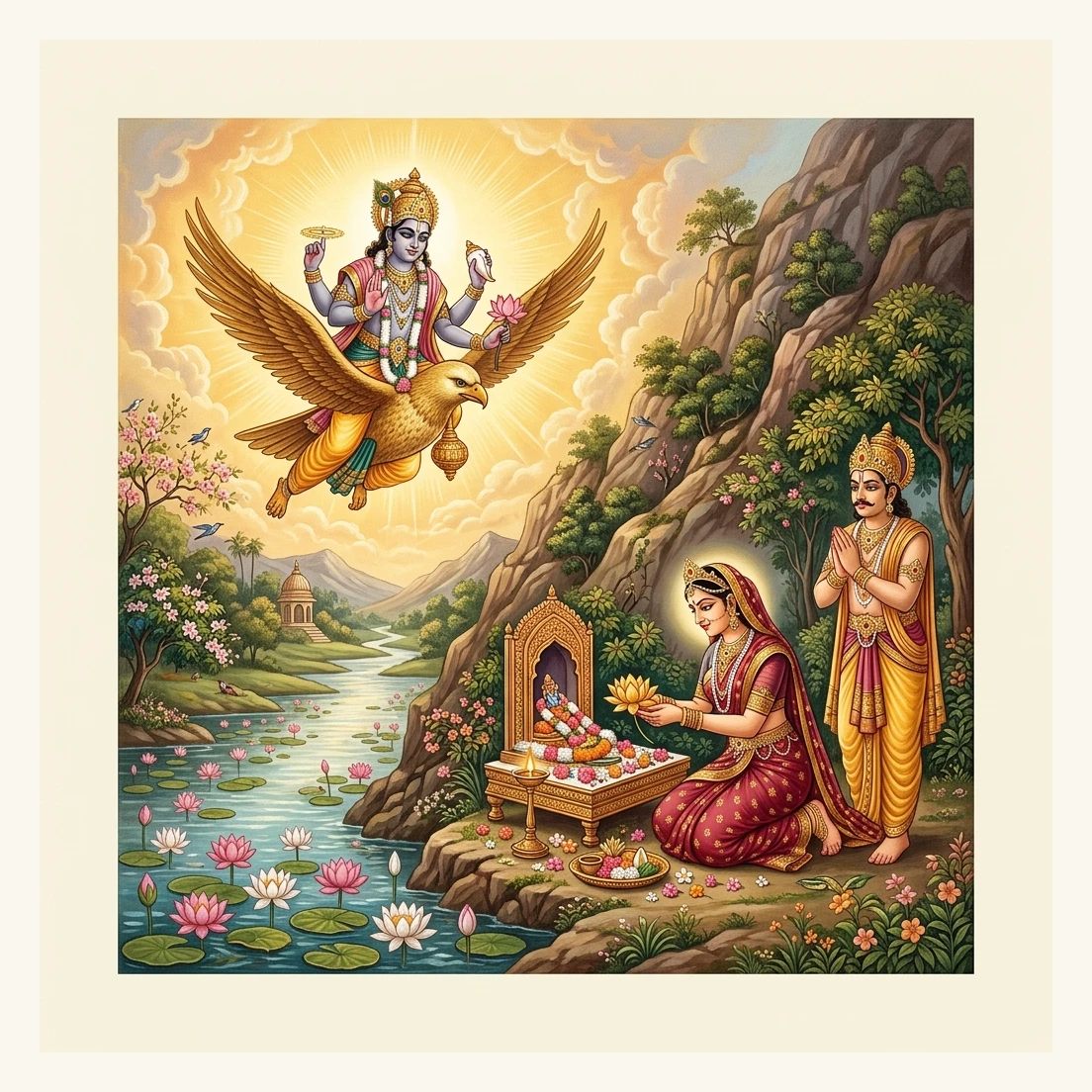
The lord came to Padminī first — pleased with her chastity, her years of patience in the forest, her precise observance of the vow she had been given. I am very happy with you, the lord said to her. There is no month dearer to me than this one. The Ekādaśīs that occur in this month are dearer to me than any other. You have followed Anasūyā's instructions perfectly. I will do what pleases you. You and your husband shall have the son you desire.
He turned to Kṛtavīrya. O king, ask of me any boon.
The king answered with the request he had carried for ten thousand years. Grant me a son who will never be conquered — not by gods, not by humans, not by serpents, not by demons, not by hobgoblins — but whom only you can defeat.
So be it.
Viṣṇu disappeared.
Padminī returned with her husband to the kingdom. In due time she conceived. The son she bore was Kārtavīrya Arjuna — the thousand-armed king, the Haihaya emperor whose strength is praised across the Mahābhārata and the Rāmāyaṇa. He defeated the gods. He took Rāvaṇa prisoner — the same Rāvaṇa who in his next career would conquer the heavens and abduct Sītā — and freed him only at Pulastya's request.
The end of the story circles back to its frame. Pulastya was telling Nārada about Kārtavīrya Arjuna because Nārada had asked: how did this king defeat Rāvaṇa, who later defeated even Indra? Pulastya's answer was: because his mother observed the Padminī Ekādaśī.
The vow
Padminī Ekādaśī falls on the eleventh tithi of the bright fortnight of the adhika māsa — the leap month — which occurs roughly once every thirty-two to thirty-three months. The next occurrence falls on Wednesday, 27 May 2026, in the adhika Jyeṣṭha of that year.
The observance is unusually demanding. The Purāṇa prescribes a complete nirjala fast — no food, no water, from sunrise of Ekādaśī to sunrise of Dvādaśī — for those who can. Those who cannot keep nirjala may observe with permitted fruits and dairy, but the merit is then proportionally reduced. The day before, on Daśamī, the observer eats once, sleeps on the ground, and remains celibate.
On Ekādaśī, the observer worships Viṣṇu through the day — chanting the Viṣṇu Sahasranāma, reciting the names of the lord, offering tulasī leaves. The night is kept awake with bhajans and praise. On Dvādaśī morning, after worship of Viṣṇu and feeding of a brāhmaṇa, the fast is broken in the proper pāraṇa window.
The adhika māsa as a whole is a month of intensified devotion. Many observers also keep the Pancharātrika fast — five days surrounding the two Ekādaśīs of the month — which is said to remove every kind of sin.
The phalaśruti
The Skanda Purāṇa is explicit. The person who observes this fast goes to Viṣṇu Loka. The merit is described as equivalent to the merit of all other Ekādaśīs combined. The fast is said to dissolve sins accumulated not only across this lifetime but across previous incarnations.
The teaching at the heart of this Ekādaśī is in what Anasūyā gave Padminī. The king had done ten thousand years of austerity and received nothing. The queen did one day of a precisely-chosen vow and received everything. The difference was not in effort. The king's effort was incomparable. The difference was in time — the specific day, the rare month, the alignment of intention with the rhythm of the cosmos.
The orphan month — the one that belongs to no season — is the one in which the highest results come most easily. The Purāṇa is making a quiet point: there are doors in the calendar that open only rarely, and when they open, what could not be obtained by years of work can sometimes be obtained by one well-kept day.
Source: Skanda Purāṇa, with parallel references in the Padma Purāṇa and the Bhaviṣyottara Purāṇa. The principal narrative is preserved as a conversation between Kṛṣṇa and Yudhiṣṭhira, with the inner story recited by the sage Pulastya to Nārada. The Skanda Purāṇa is the largest of the eighteen Mahāpurāṇas (over 81,000 verses), with a full English translation by G. V. Tagare available in the Ancient Indian Tradition and Mythology series, vols. 49–71 (Motilal Banarsidass, Delhi). The full English translation is freely available at wisdomlib.org.
Frequently asked
- What is Padminī Ekadasi?
- Padminī Ekadasi is the ekādaśī tithi — the eleventh lunar day — of the waxing fortnight (śukla pakṣa) of Adhika Māsa. Its name means "the lotus-named, of the leap month". Like every Ekadasi, it is observed by fasting and remembrance of Lord Viṣṇu. The story and fruits (phalaśruti) of Padminī are recorded in Skanda Purāṇa (with parallel references in the Padma Purāṇa and the Bhaviṣyottara Purāṇa).
- When is Padminī Ekadasi observed?
- Padminī Ekadasi falls on the ekādaśī tithi of the waxing fortnight of Adhika Māsa (the Hindu lunar month). The exact Gregorian date varies each year because the lunar calendar drifts relative to the solar one. Smārta and Vaiṣṇava observers occasionally fast on different civil days when the tithi spans two sunrises — see the date above for the next occurrence.
- Who is worshipped on Padminī Ekadasi?
- Padminī Ekadasi, like all Ekadasis, is dedicated to Viṣṇu (as Puruṣottama). Specific forms of worship vary by tradition: chanting Viṣṇu-sahasranāma, reading the corresponding chapter from Skanda Purāṇa (with parallel references in the Padma Purāṇa and the Bhaviṣyottara Purāṇa), hearing the story, and remembering the divine names are all considered part of the observance.
- What is the spiritual fruit (phalaśruti) of observing Padminī Ekadasi?
- The Purāṇic source declares that observing Padminī Ekadasi yields: Equivalent to all other Ekādaśīs combined; observance grants Vaikuṇṭha; once observed in every thirty-two months. Across all Ekadasis, the underlying claim is the same — the fast aligns the body, breath, and mind with the eleventh lunar day's particular quietness, and bestows merit equivalent to extensive austerities, charity, or pilgrimage.
- How is Padminī Ekadasi observed?
- A complete observance begins the previous evening with a light, sattvic meal and continues into a fast on Ekadasi day. The fast can be nirjala (without water), phalāhāra (fruits and water), or a single sattvic meal — pick the level your health and discipline allow. Grains, pulses, onions, and garlic are universally avoided on Ekadasi. The fast is broken on Dvādaśī during the prescribed pāraṇa window listed on this page. The day is spent in remembrance — chanting, reading, hearing the Ekadasi story, and avoiding sleep during daylight where possible.
- What is the difference between Smārta and Vaiṣṇava observance of Padminī Ekadasi?
- On most Ekadasis the two traditions fast on the same day. They diverge only in the rare atirikta case — when the Ekadasi tithi spans two consecutive sunrises. Smārtas fast on the first such day; Vaiṣṇavas wait until the next, preferring that Dvādaśī also touches sunrise. If Padminī Ekadasi falls in such a fortnight in a given year, the two dates will appear on this page side by side.
Found an error?
ekadasi.day has no ads and no popups. If a date, name, or story reads wrong, please write — accuracy matters more than reach.
feedback@ekadasi.day →·Other ways to help