Pauṣa · Kṛṣṇa Pakṣa

Saphalā Ekadasi

The fruitful one

Next observedSaturday, 9 January 2021

Next occurrence

Saturday, January 9, 2021

Ekadasi tithi
Fri
8 Jan
11:10 AM
Dvādaśī begins
Sat
9 Jan
8:47 AM
Hari Vāsara ends
Sat
9 Jan
8:47 AM
Pāraṇa window
Sun
10 Jan
7:53 AM – 7:54 AM

The exile who accidentally fasted

Retold from the Padma Purāṇa, Uttara Khaṇḍa, Chapter 40. The standard English translation, on which this retelling relies, is by N.A. Deshpande (Motilal Banarsidass).

The story of Saphalā Ekādaśī is the story of a man who did not know he was observing it.

Long ago, in the city of Campāvatī, there lived a king of the Māhiṣmata line who had five sons. Four were what a king would hope for. The fifth was not. The eldest, in fact, was the kind of disappointment that rearranges a family. He was a drunkard. He kept company with prostitutes. He committed adultery. He insulted brāhmaṇas and mocked Viṣṇu's devotees. He spent his father's money on pleasures and his father's reputation on shame.

His father gave up on him. He gave him a name to match what he had become: Lumpaka — the robber. Then he expelled him from the kingdom. The other brothers cast him out. Even the palace attendants turned their backs.

Lumpaka, alone now, did not repent. He resolved instead to plunder the city that had refused him. He went into a dense forest beyond the kingdom and made it his base. He became, the text says without flinching, the treasure of the arts of stealing and gambling. He killed creatures for food. He raided his father's city by night. Once the night-watch caught him, but when they discovered who he was, they let him go.

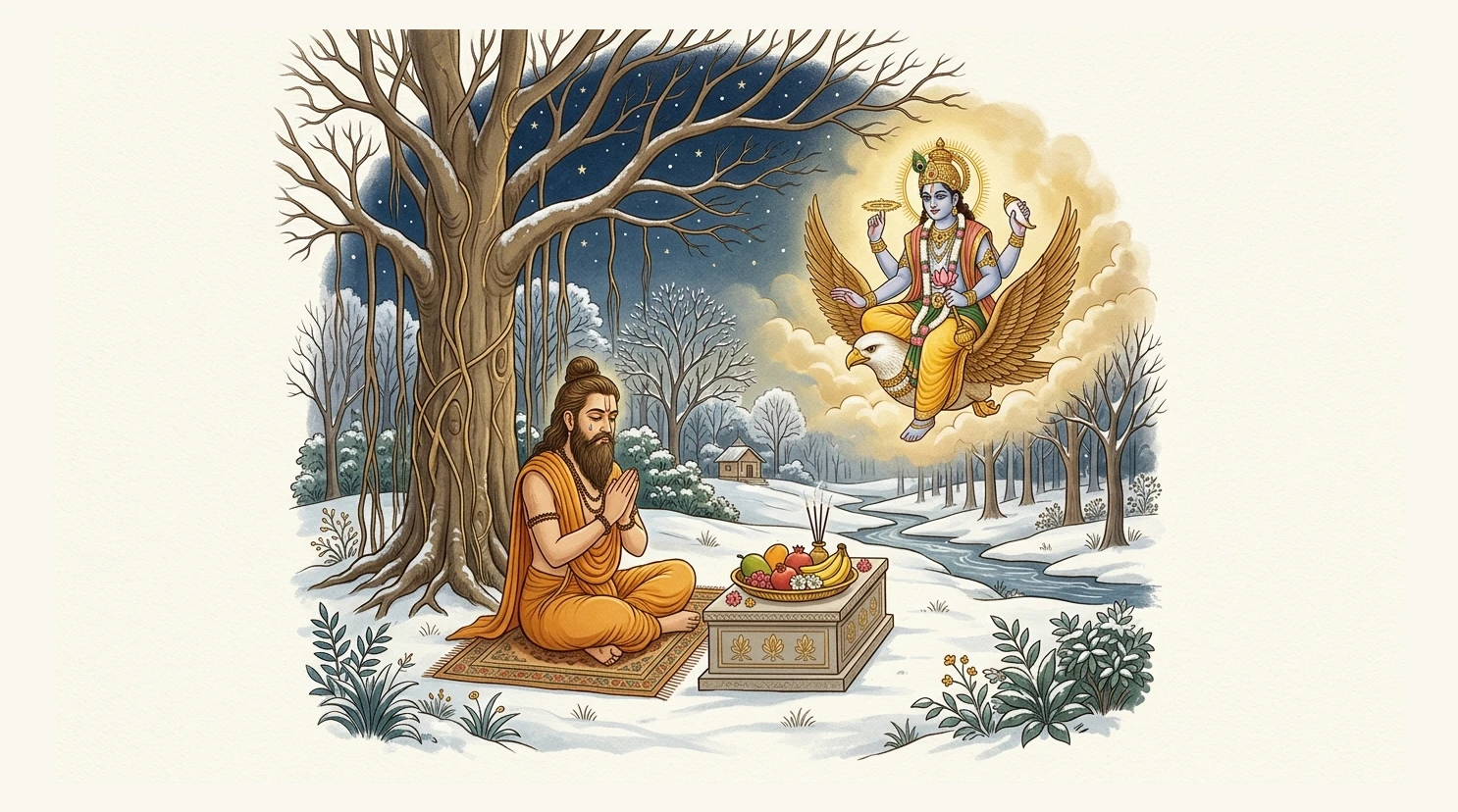
He lived this way for many years, beside a single tree.

The tree was an Aśvattha, ancient, the kind of tree under which gods are said to dwell. The Purāṇa is specific about this: the tree had great divineness, and was an abode of Viṣṇu. Lumpaka did not know that. He only knew it was where he slept.

Then came the dark fortnight of the month of Pauṣa. The tenth day. Lumpaka, who had no calendar and no reverence, happened that day to eat only fruits — there was nothing else.

The eleventh day arrived. Saphalā.

That day a wind came up. Lumpaka had no clothes. He lost his sight to the cold. The night brought a chill so severe that he could not sleep beneath the tree, could only cover his lips with his teeth and shiver. He was, the text says, as it were dead. Sunrise came; he did not wake. He lay unconscious through what should have been the morning meal.

By midday he stirred. He could not walk straight; he stumbled into the forest like a lame man. He was too weak now to hunt. He could find no fruits. By sunset, hungry and broken, he began to cry. O pity, he said aloud to the indifferent trees, what will happen to me?

Then, with what he had — fruits he had found earlier and not eaten, the only thing of any value to a man with nothing — he made an offering at the root of the Aśvattha tree.

May Viṣṇu be pleased with these fruits.

He spoke without knowing what day it was. Without knowing the tree was sacred. Without knowing he had unwittingly observed the fast of Saphalā Ekādaśī — by failing to eat through the day, by lying awake through the night, by offering food to Viṣṇu at the foot of his abode. He did not sleep that second night either. He could not.

Viṣṇu received all of it. He took the failure to eat as a fast. He took the inability to sleep as a vigil. He took the despairing offering of fruits as worship.

At sunrise, a divine voice spoke from above the tree. By the favour of Saphalā, O son, you will obtain the kingdom.

Lumpaka said only, All right.

But something in him had changed. He became — the text uses these exact words — one of a divine form. He returned to his father's city, was received as a son, and was given the kingdom. He ruled for fifteen years. By Kṛṣṇa's favour he was given a charming wife and charming children. When the time came, he abdicated to his son and went to Kṛṣṇa's proximity, where, the text says, a man does not meet with grief.

The vow

Saphalā Ekādaśī is observed on the eleventh tithi of the dark fortnight of Pauṣa. The fast is broken the following morning in the pāraṇa window after sunrise.

The chapter is specific about the fruits used in worship: coconuts, betel nuts, citron fruits, jambīra (lemon), pomegranates, dhātrī (āmlā), cloves, badari (jujube), and especially mangoes. Incense and lights are offered, with particular emphasis on the gift of lights. The night is kept awake in the company of Viṣṇu's devotees.

Listen, Kṛṣṇa tells Yudhiṣṭhira, to the religious merit of him, of a concentrated mind, who keeps awake during that night just for the time of the twinkling of an eye. No sacrifice is equal to that.

The phalaśruti

The chapter places Saphalā high in the hierarchy of vows. As Śeṣa is the best of serpents, Kṛṣṇa says, as Garuḍa is the best of birds, as Viṣṇu is the best of deities, as the brāhmaṇa is the best of bipeds — so the day of Ekādaśī is the best of vows.

For the observer, the fruit is the Rājasūya sacrifice — the imperial sacrifice that consecrated emperors. For one who keeps awake for even the twinkling of an eye, the merit exceeds penance practiced for thousands of years. All other vows do not deserve even the sixteenth part of the Saphalā-vow.

The deeper teaching of this Ekādaśī sits at its centre. Lumpaka did not observe the vow knowingly. He observed it because he was too weak to eat and too cold to sleep, and because in despair he made a small offering at a tree that turned out to be holy. Viṣṇu does not require knowledge of the day, the text quietly suggests. He requires only what was given: emptiness and offering.

Source: Padma Purāṇa, Uttara Khaṇḍa, Chapter 40, "Saphalā Ekādaśī." Translated by N.A. Deshpande in Ancient Indian Tradition and Mythology series, vols. 39–48 (Motilal Banarsidass, Delhi, ISBN 9788120838291). The full English translation is freely available at wisdomlib.org.

Frequently asked

What is Saphalā Ekadasi?
Saphalā Ekadasi is the ekādaśī tithi — the eleventh lunar day — of the waning fortnight (kṛṣṇa pakṣa) of Pauṣa. Its name means "the fruitful one". Like every Ekadasi, it is observed by fasting and remembrance of Lord Viṣṇu. The story and fruits (phalaśruti) of Saphalā are recorded in Padma Purāṇa, Uttara Khaṇḍa, Chapter 40.
When is Saphalā Ekadasi observed?
Saphalā Ekadasi falls on the ekādaśī tithi of the waning fortnight of Pauṣa (the Hindu lunar month). The exact Gregorian date varies each year because the lunar calendar drifts relative to the solar one. Smārta and Vaiṣṇava observers occasionally fast on different civil days when the tithi spans two sunrises — see the date above for the next occurrence.
Who is worshipped on Saphalā Ekadasi?
Saphalā Ekadasi, like all Ekadasis, is dedicated to Viṣṇu. Specific forms of worship vary by tradition: chanting Viṣṇu-sahasranāma, reading the corresponding chapter from Padma Purāṇa, Uttara Khaṇḍa, Chapter 40, hearing the story, and remembering the divine names are all considered part of the observance.
What is the spiritual fruit (phalaśruti) of observing Saphalā Ekadasi?
The Purāṇic source declares that observing Saphalā Ekadasi yields: The merit of a Rājasūya sacrifice; turns even an unconscious observance into salvation. Across all Ekadasis, the underlying claim is the same — the fast aligns the body, breath, and mind with the eleventh lunar day's particular quietness, and bestows merit equivalent to extensive austerities, charity, or pilgrimage.
How is Saphalā Ekadasi observed?
A complete observance begins the previous evening with a light, sattvic meal and continues into a fast on Ekadasi day. The fast can be nirjala (without water), phalāhāra (fruits and water), or a single sattvic meal — pick the level your health and discipline allow. Grains, pulses, onions, and garlic are universally avoided on Ekadasi. The fast is broken on Dvādaśī during the prescribed pāraṇa window listed on this page. The day is spent in remembrance — chanting, reading, hearing the Ekadasi story, and avoiding sleep during daylight where possible.
What is the difference between Smārta and Vaiṣṇava observance of Saphalā Ekadasi?
On most Ekadasis the two traditions fast on the same day. They diverge only in the rare atirikta case — when the Ekadasi tithi spans two consecutive sunrises. Smārtas fast on the first such day; Vaiṣṇavas wait until the next, preferring that Dvādaśī also touches sunrise. If Saphalā Ekadasi falls in such a fortnight in a given year, the two dates will appear on this page side by side.

Found an error?

ekadasi.day has no ads and no popups. If a date, name, or story reads wrong, please write — accuracy matters more than reach.

feedback@ekadasi.day →·Other ways to help
Saphalā Ekādaśī · ekadasi.day