Phālguna · Kṛṣṇa Pakṣa
Vijayā Ekadasi
The victory
Next occurrence
Thursday, February 12, 2026
- Ekadasi tithi
- Thu
- 12 Feb
- 1:52 AM
- Dvādaśī begins
- Fri
- 13 Feb
- 3:56 AM
- Hari Vāsara ends
- Fri
- 13 Feb
- 3:56 AM
- Pāraṇa window
- Fri
- 13 Feb
- 7:26 AM – 10:06 AM
The vow that crossed the ocean
Retold from the Padma Purāṇa, Uttara Khaṇḍa, Chapter 44. The standard English translation, on which this retelling relies, is by N.A. Deshpande (Motilal Banarsidass).
Kṛṣṇa tells Yudhiṣṭhira this story by way of telling him a story Brahmā once told Nārada. The story is about an ocean.
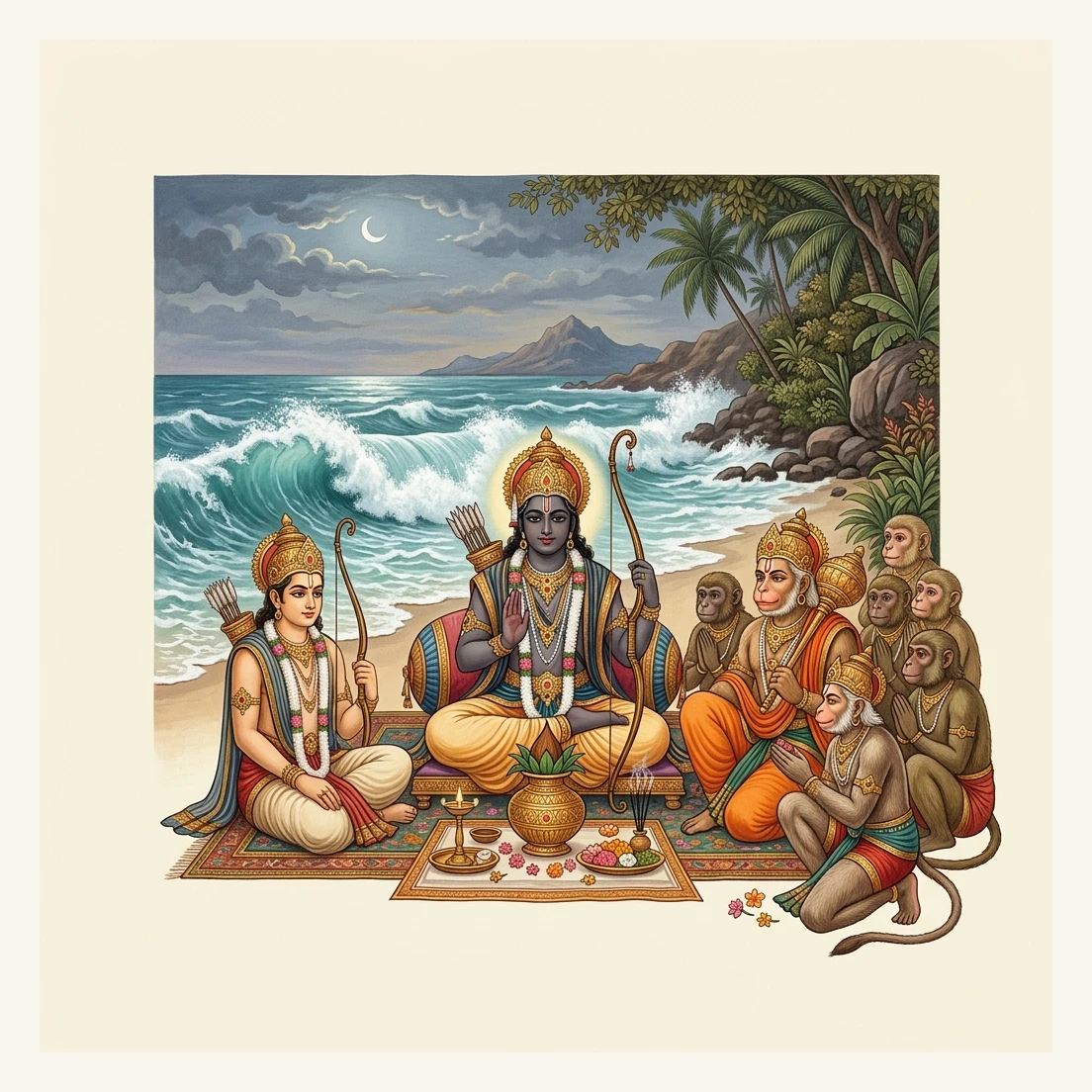
Rāma, the son of Daśaratha, had completed his fourteen years in the forest. He had lost Sītā to Rāvaṇa, who had taken her in lust. He had seen the dying Jaṭāyus, killed the demon Kabandha, befriended the monkey-king Sugrīva, gathered the forces of the Vānaras. Hanumān had crossed to Laṅkā, seen Sītā in the Aśoka garden, given her Rāma's token, returned. The decision had been made. The march would begin.
But there was an ocean in the way.
Rāma stood on the shore. He was the seventh incarnation of Viṣṇu, although in this life he did not always remember it. He looked out at what the Purāṇa calls the unfathomable abode of Varuṇa, full of aquatic creatures — the great sea between him and his wife — and he turned to his brother.
O Saumitra, he said — Saumitra being Lakṣmaṇa, son of Sumitrā — by which religious merit can this ocean, full of aquatic animals, be crossed? I do not see a means with which it can be crossed easily.
Lakṣmaṇa thought for a moment. Then he gave the answer that brothers give brothers in trouble: someone wiser than us is nearby.
You alone are the first god, Lakṣmaṇa said, with that careful formality the Rāmāyaṇa reserves for one brother to another. On this island lives the sage Bakadālbhya. His hermitage is half a yojana from here. There are many other brāhmaṇas there also. Go and ask the best sage.
Rāma went. He approached the hermitage, bowed his head, and saluted the sage as a god salutes Viṣṇu — which is to say, with full prostration. The sage was old enough and wise enough to recognize who Rāma actually was. He had not forgotten that the ancient best man sometimes walked the earth in human bodies for reasons of his own. He was pleased.
O Rāma, the sage said. What for have you come?
Rāma did not pretend. O brāhmaṇa, by your favour I have come along with the army to this shore of the ocean to conquer Laṅkā along with the demons. Tell me the means by which I shall cross the ocean.
Bakadālbhya considered. Then he gave Rāma the answer.
O Rāma, today you should observe the best among vows, having observed which you will be mightily victorious. Having conquered Laṅkā and the demons, you will obtain pure fame. The Vijayā Ekādaśī will fall in the dark half of the month of Phālguna. By the observance of that vow you will get victory. You will, along with the monkeys, undoubtedly cross the ocean.
The sage taught Rāma the vow in detail.
On the tenth day, he said, you should have a pitcher fashioned — of gold, silver, copper, or clay. Fill it with water and place fresh sprouts in it. Beneath it, put seven kinds of grain. Place barley above. On the pitcher set a golden image of Nārāyaṇa, the lord. When the eleventh day comes, bathe in the morning, place a wreath at the neck of the pitcher, apply fragrances, and keep it steady. Worship it especially with betel nuts and coconuts, with sandalwood, with incense, with lamps, with various offerings of food. Spend the day before this pitcher hearing good tales. Keep awake at night before it. Light a lamp of ghee and keep the vow continuously. On the twelfth day, on the rising of the sun, take the jar to a river or a stream and place it in the water. Worship it again. Then give the jar to a brāhmaṇa who has mastered the Vedas, with the great gifts.
Observe this carefully, the sage said. Along with the chiefs of your troops. You will be victorious.
Rāma did. He did exactly what he was told.
When he had observed the vow with his commanders, the ocean was bridged. The march succeeded. He crossed with the monkeys. He conquered Laṅkā. He killed Rāvaṇa in the battle. He got Sītā back.
For this reason, Brahmā tells Nārada at the end of the chapter, the vow of Vijayā should be observed.
The vow
Vijayā Ekādaśī is observed on the eleventh tithi of the dark fortnight of Phālguna. The fast is broken on Dvādaśī.
What distinguishes this Ekādaśī's observance is the pitcher (kalaśa) ritual described in detail above. The pitcher is the focus of worship through the day and night. On Dvādaśī morning, after worship, the pitcher is taken to flowing water — a river or stream — and placed there as an offering. The contents are then given to a Vedic brāhmaṇa.
This is the Ekādaśī observed by those facing an obstacle they cannot see how to cross. The form Rāma faced was an ocean. The form a present-day observer faces may be illness, litigation, a closed door, a hostile circumstance. The observance is not magical thinking — it is the deliberate creation, on a single specific day, of the inner state in which a person becomes capable of finding the bridge.
The phalaśruti
The merit of Vijayā is described in royal terms because the story is royal. Vijayā gives victory to kings. Those who observe it get success in this world and get the inexhaustible other world. Reciting or hearing the account gives the fruit of the Vājapeya sacrifice — the imperial ritual whose name means the drink of strength.
But the vow is not only for those marching on Laṅkā. Rāma, after all, was not asking for the ocean to be defeated — he was asking for the wisdom to know how to face it. The pitcher full of water and grain, prepared the day before, stood as a reminder through the long observance: there is a vessel that holds what you need. You only have to keep watch with it through the night.
Source: Padma Purāṇa, Uttara Khaṇḍa, Chapter 44, "Vijayā Ekādaśī." Translated by N.A. Deshpande in Ancient Indian Tradition and Mythology series, vols. 39–48 (Motilal Banarsidass, Delhi, ISBN 9788120838291). The full English translation is freely available at wisdomlib.org.
Frequently asked
- What is Vijayā Ekadasi?
- Vijayā Ekadasi is the ekādaśī tithi — the eleventh lunar day — of the waning fortnight (kṛṣṇa pakṣa) of Phālguna. Its name means "the victory". Like every Ekadasi, it is observed by fasting and remembrance of Lord Viṣṇu. The story and fruits (phalaśruti) of Vijayā are recorded in Padma Purāṇa, Uttara Khaṇḍa, Chapter 44.
- When is Vijayā Ekadasi observed?
- Vijayā Ekadasi falls on the ekādaśī tithi of the waning fortnight of Phālguna (the Hindu lunar month). The exact Gregorian date varies each year because the lunar calendar drifts relative to the solar one. Smārta and Vaiṣṇava observers occasionally fast on different civil days when the tithi spans two sunrises — see the date above for the next occurrence.
- Who is worshipped on Vijayā Ekadasi?
- Vijayā Ekadasi, like all Ekadasis, is dedicated to Viṣṇu (as Nārāyaṇa). Specific forms of worship vary by tradition: chanting Viṣṇu-sahasranāma, reading the corresponding chapter from Padma Purāṇa, Uttara Khaṇḍa, Chapter 44, hearing the story, and remembering the divine names are all considered part of the observance.
- What is the spiritual fruit (phalaśruti) of observing Vijayā Ekadasi?
- The Purāṇic source declares that observing Vijayā Ekadasi yields: Gives victory to kings; fruit of the Vājapeya sacrifice; success in this world and the permanent next world. Across all Ekadasis, the underlying claim is the same — the fast aligns the body, breath, and mind with the eleventh lunar day's particular quietness, and bestows merit equivalent to extensive austerities, charity, or pilgrimage.
- How is Vijayā Ekadasi observed?
- A complete observance begins the previous evening with a light, sattvic meal and continues into a fast on Ekadasi day. The fast can be nirjala (without water), phalāhāra (fruits and water), or a single sattvic meal — pick the level your health and discipline allow. Grains, pulses, onions, and garlic are universally avoided on Ekadasi. The fast is broken on Dvādaśī during the prescribed pāraṇa window listed on this page. The day is spent in remembrance — chanting, reading, hearing the Ekadasi story, and avoiding sleep during daylight where possible.
- What is the difference between Smārta and Vaiṣṇava observance of Vijayā Ekadasi?
- On most Ekadasis the two traditions fast on the same day. They diverge only in the rare atirikta case — when the Ekadasi tithi spans two consecutive sunrises. Smārtas fast on the first such day; Vaiṣṇavas wait until the next, preferring that Dvādaśī also touches sunrise. If Vijayā Ekadasi falls in such a fortnight in a given year, the two dates will appear on this page side by side.
Found an error?
ekadasi.day has no ads and no popups. If a date, name, or story reads wrong, please write — accuracy matters more than reach.
feedback@ekadasi.day →·Other ways to help