Govardhana Pūjā
Kārtika Śukla Pratipadā · The day Kṛṣṇa lifted the hill on his finger
Govardhana Pūjā
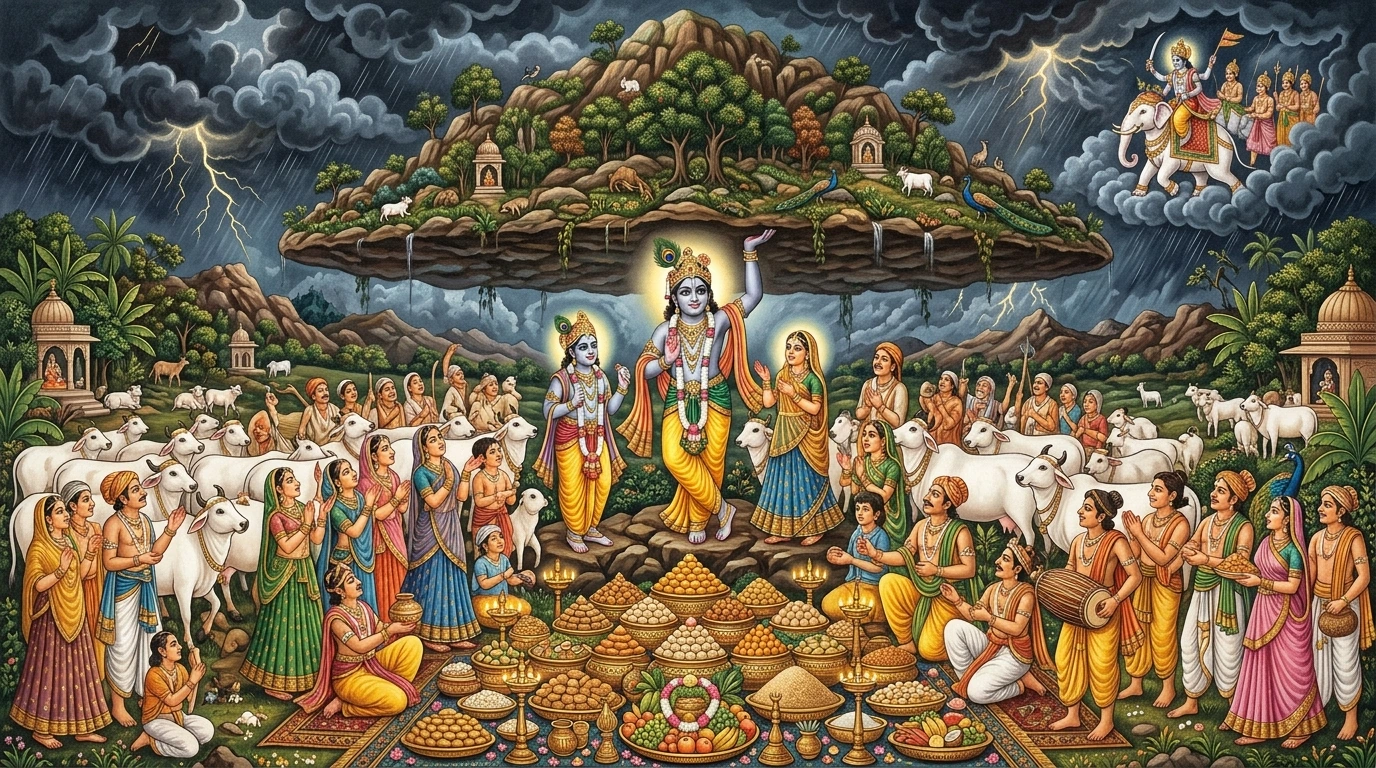
Commemorates Lord Kṛṣṇa lifting the Govardhana hill upon his little finger for seven days to shelter Vraja from torrential storms, redirecting worship from celestial demigods to nature and the sacred cows.
The Significance of Govardhana Pūjā
The hill held up against the storm
Retold from the Bhāgavata Purāṇa, Canto 10, Chapters 24 and 25. The English translation relied on here is that of A.C. Bhaktivedanta Swami Prabhupāda (Bhaktivedanta Book Trust).
Every year the people of Vraja prepared a great sacrifice to Indra, king of the gods and lord of the rains. The boy Kṛṣṇa asked his father and the elders a plain question: why Indra? We are cowherds, he said in effect; our living is the cattle and the land and the hill that feeds them. Indra sends rain by his nature, whether worshipped or not; better to honour what actually sustains us, the cows, the brāhmaṇas, and Govardhana hill, whose grass and water keep the herds alive. So at his word the offering meant for Indra was given instead to the hill, and the cattle were led around it.
Indra was enraged at being passed over by a village of cowherds, and he sent down the Sāṁvartaka clouds, the clouds of the end of an age, to drown Vraja in a deluge of rain and wind and hail. It was punishment meant to break them.
Kṛṣṇa walked to Govardhana, lifted the entire hill on the little finger of his left hand, and held it up like an umbrella. The whole of Vraja: people, cattle, all of them, sheltered beneath it, dry, while the storm spent itself for seven days against a hill held on a child’s finger. Indra, his fury exhausted and useless, finally understood whom he had been raining on, and came down to bow.
The teaching is folded into the action. Indra is power that expects to be feared and worshipped for its own sake; Kṛṣṇa redirects worship to what truly nourishes, the earth, the hill, the herds, and then, when wounded pride strikes back, simply shelters everyone under the very thing they had honoured. The hill they had been taught to thank became the roof that saved them.
What is done, and why
On Govardhana Pūjā, a hill of food is built, Annakūṭa, the “mountain of food,” a great heap of cooked dishes offered to Kṛṣṇa and then shared, and a small Govardhana is often made of cowdung or earth, decorated and circumambulated, with the cattle honoured. It is a festival of abundance and gratitude to what feeds us, and a refusal of worship that is only fear. It falls the day after Dīpāvali.
How it is kept
Govardhana Pūjā falls on Kārtika Śukla Pratipadā, the first day of the bright fortnight, the day after the Dīpāvali new moon.
Why it is kept
The story turns worship from fear toward gratitude. Kṛṣṇa stops the people thanking the god they were afraid of and turns them to the hill that actually fed them, and then proves the point by making that same hill their shelter. The mountain of food each year is the answer to Indra: honour what sustains you, and you will be kept.
Source: Bhāgavata Purāṇa, Canto 10, Chapters 24–25 (the lifting of Govardhana), available at vedabase.io.
How it is observed
No fast, a mountain of food (annakūṭa) is offered to Kṛṣṇa in remembrance of his lifting Govardhana hill to shelter Vraja.
- Create a symbolic Govardhana hill model using cow-dung, flowers, or sweets.
- Prepare an elaborate mountain of food (Annakūṭa) featuring 56 diverse vegetarian dishes (Chappan Bhog).
- Bathe and adorn cows (Go-Pūjā) with turmeric, garlands, and feed them fresh green grass and jaggery.
- Perform circumambulation (Parikramā) of the Govardhana hill in reverence.
In Vedic astronomy, Rāhu is the shadow node (chāyā-graha) associated with illusion, darkness, and disruption. No new sacred endeavor, pūjā sankalpa, or idol installation (sthāpanā) should ever be commenced during Rāhu Kāla. Ongoing chanting or meditation may continue, but the initial invocation must never begin during this window.
Governed by Yama, the lord of mortality and justice. It is considered unfavorable for establishing enduring auspiciousness and prosperity; hence ritual beginnings and vows are suspended during this hour.