Navarātri begins
Āśvina Śukla Pratipadā · Nine nights of the Goddess, the war no god could win

Navarātri begins
Ghaṭasthāpana (installing the sacred pot / kalaśa) initiates the nine-night worship of Goddess Durgā. The morning hours of Pratipadā are designated for invoking the mother’s cosmic presence.
The Significance of Navarātri begins
The demon no man or god could kill
Retold from the Devī Māhātmya (the Durgā Saptaśatī*), set within the* Mārkaṇḍeya Purāṇa. The English translation relied on here is that of F.E. Pargiter and the standard Gita Press rendering.
The buffalo-demon Mahiṣāsura had won, by long austerity, a boon that no man and no god could kill him, and on the strength of it he drove the gods out of heaven and took it for himself. The defeated gods went to Viṣṇu and Śiva, and out of the gathered wrath of all of them a light poured forth, from Śiva her face, from Viṣṇu her arms, from the others her every limb, and the light took form as a woman, Durgā, more radiant and more terrible than any of them alone. Each god gave her his weapon: Śiva’s trident, Viṣṇu’s discus, Indra’s thunderbolt, and the rest. She had no place in the demon’s careful boon. He had warded himself against men and gods, and forgotten the Goddess.
The war is the heart of the Devī Māhātmya, fought over nine nights, Navarātri. She destroys the demon generals one after another, Caṇḍa and Muṇḍa, from whom she takes the name Cāmuṇḍā; Raktabīja, every drop of whose blood became a new demon, until she drank the blood before it could fall. And at last she meets Mahiṣāsura himself, who shifts shape, buffalo, lion, man, back to buffalo, and on the tenth day she pins him and strikes off his head. Heaven is restored.
The nine nights are traditionally read as the Goddess in three movements of three: first as Durgā/Kālī, destroying what is corrupt; then as Lakṣmī, establishing what is good; then as Sarasvatī, the wisdom that crowns it. The work is not only war but the whole arc, clearing, settling, illumining.
The 10-Day Journey: Navadurgā and Vijayadaśamī
The nine sacred nights and the triumphant tenth day form a continuous spiritual ascent:
-
Nights 1–3 (Days 1–3): Durgā/Kālī Tattva — Uprooting Obstacles and Inertia
- Day 1 (Pratipadā): Mā Śailaputrī — Awakening and grounding spiritual aspiration at the Mūlādhāra. Ghaṭasthāpana and Akhaṇḍa Dīpa.
- Day 2 (Dvitīyā): Mā Brahmacāriṇī — The severe penance (tapas) of the Goddess; cultivating willpower, silence, and truthfulness.
- Day 3 (Tṛtīyā): Mā Candraghaṇṭā — The bell-crescent moon that strikes fear into darkness and calms the seeker’s mind.
-
Nights 4–6 (Days 4–6): Lakṣmī Tattva — Cultivating Divine Virtues and Vitality
- Day 4 (Caturthī): Mā Kūṣmāṇḍā — The cosmic smile that created the golden universe (Brahmāṇḍa); solar vitality in the Anāhata heart.
- Day 5 (Pañcamī): Mā Skandamātā — The divine mother cradling infant commander Skanda; maternal grace, pure speech, and protection.
- Day 6 (Ṣaṣṭhī): Mā Kātyāyanī — The warrior maiden born of cosmic fire; commencement of community Durgā Pūjā (Bodhana).
-
Nights 7–9 (Days 7–9): Sarasvatī Tattva — Transcendental Wisdom and Realization
- Day 7 (Saptamī): Mā Kālarātri — Midnight destroyer of darkness and fear; overcoming mortality and the shadow ego.
- Day 8 (Aṣṭamī): Mā Mahāgaurī — The conch-white purity after the Gaṅgā bath; the crucial Sandhi Pūjā and Kanyā Pūjā.
- Day 9 (Navamī): Mā Siddhidātrī — Giver of all eight divine perfections (Siddhis); Mahānavamī Homa and pūrṇāhuti.
-
Day 10 (Daśamī): Vijaya Tattva — The Triumph of Cosmic Dharma
- Day 10 (Vijayadaśamī / Daśaharā): Aparājitā Durgā & Śrī Rāma — Victory over Mahiṣāsura and Rāvaṇa; Śamī Pūjā, Vidyārambha, and breaking of the fast (Pāraṇā).
Explore the comprehensive interactive day-by-day guide below, complete with authentic classical oil paintings, daily rituals, offerings, and Sanskrit chants.
What is done, and why
Navarātri opens with Ghaṭasthāpana: the installing of a pot, often sown with barley, as the seat of the Goddess for the nine nights. The days are kept with fasting (many take only fruit and a single sattvic meal), recitation of the Durgā Saptaśatī, and in much of the country garba and dāṇḍiyā danced through the night around the lamp. The barley sprouts over the nine days, the visible answer to the worship.
How it is kept
Navarātri begins on Āśvina Śukla Pratipadā with Ghaṭasthāpana, and runs nine nights to the ninth (Mahānavamī); the tenth day is Vijayadaśamī.
Why it is kept
The festival rests on the gap in Mahiṣāsura’s boon. He sealed himself against men and gods and never thought of the Goddess, and it is precisely the power he discounted that ends him. Navarātri is nine nights of honouring that power: the śakti that the careful and the proud forget, and that is, in the end, the one that wins.
Source: Devī Māhātmya (Durgā Saptaśatī), within the Mārkaṇḍeya Purāṇa, the slaying of Mahiṣāsura over the nine nights. Available at wisdomlib.org.
How to keep the fast
Many keep a grain-free fast across the nine nights, phalāhāra or a single sattvic meal, with daily worship of the Goddess from the ghaṭasthāpana (installing the pot) on the first day.
Breaking the fast, The nine-day fast is broken on the tenth day, Vijayadaśamī.
- Prepare a clay dish filled with sacred earth and sow seven types of grains (sapta-dhānya).
- Fill an earthen or copper kalaśa with pure water, coins, betel nut, and mango leaves.
- Place a raw coconut wrapped in red cloth (moli) atop the kalaśa.
- Light the sacred Akhaṇḍa Jyoti (uninterrupted lamp) to burn throughout the nine days.
In Vedic astronomy, Rāhu is the shadow node (chāyā-graha) associated with illusion, darkness, and disruption. No new sacred endeavor, pūjā sankalpa, or idol installation (sthāpanā) should ever be commenced during Rāhu Kāla. Ongoing chanting or meditation may continue, but the initial invocation must never begin during this window.
Governed by Yama, the lord of mortality and justice. It is considered unfavorable for establishing enduring auspiciousness and prosperity; hence ritual beginnings and vows are suspended during this hour.
Vedic rules specifically proscribe performing Ghaṭasthāpana during the prevalence of Chitrā Nakṣatra or Vaidhṛti Yoga on Pratipadā morning.
The 10 Sacred Days of Navarātri
The complete day-by-day spiritual system: authentic Purāṇic manifestation stories, classical 19th-century Raja Ravi Varma meditative oil paintings, daily ritual disciplines, and sacred Sanskrit chants.
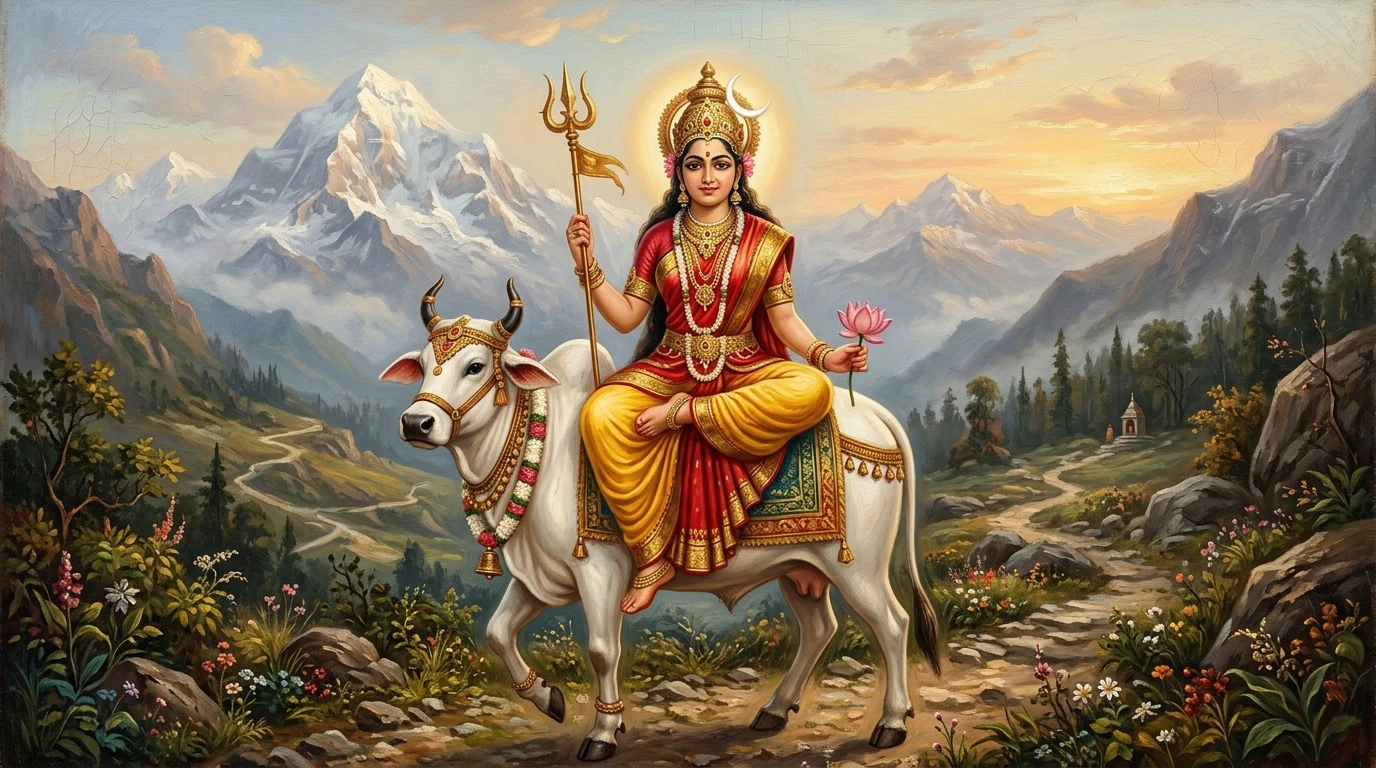
Mā Śailaputrī seated in serene majesty upon the white Nandi bull with triśūla and sacred lotus, painted in authentic Raja Ravi Varma heritage style.
Destruction of deep-rooted negative tendencies, inertia (tamas), and physical attachments.
शैलपुत्री
The Divine Daughter of the Himalayas
Luminous warmth, joy, intellectual clarity, and divine auspiciousness.
Offered for complete freedom from physical illness and granting enduring longevity.
The Sacred Manifestation of Śailaputrī
In her previous incarnation, the Divine Mother was born as Satī, the daughter of Prajāpati Dakṣa, and wed Lord Śiva. When Dakṣa organized a colossal sacrificial yajña and deliberately insulted Śiva, Satī immolated herself in the sacred sacrificial fire of yogic tapas.
She subsequently reincarnated as the daughter of King Himavat (the Lord of the Himālayas) and Queen Menā. Because she was born as the daughter of the king of mountains (Śaila), she is venerated throughout the cosmos as Śailaputrī.
As the primary manifestation of Navadurgā, she embodies the supreme spiritual energy that awakens the dormant Kuṇḍalinī Śakti at the Mūlādhāra cakra, anchoring the seeker’s consciousness in unwavering devotion to the Divine.
Adorned with a radiant crescent moon (Candrārdha) upon her forehead, draped in royal yellow silk, radiating serene maternal grace.