Śarad Pūrṇimā
Āśvina Pūrṇimā · The brightest full moon, the night of the rāsa dance
Śarad Pūrṇimā
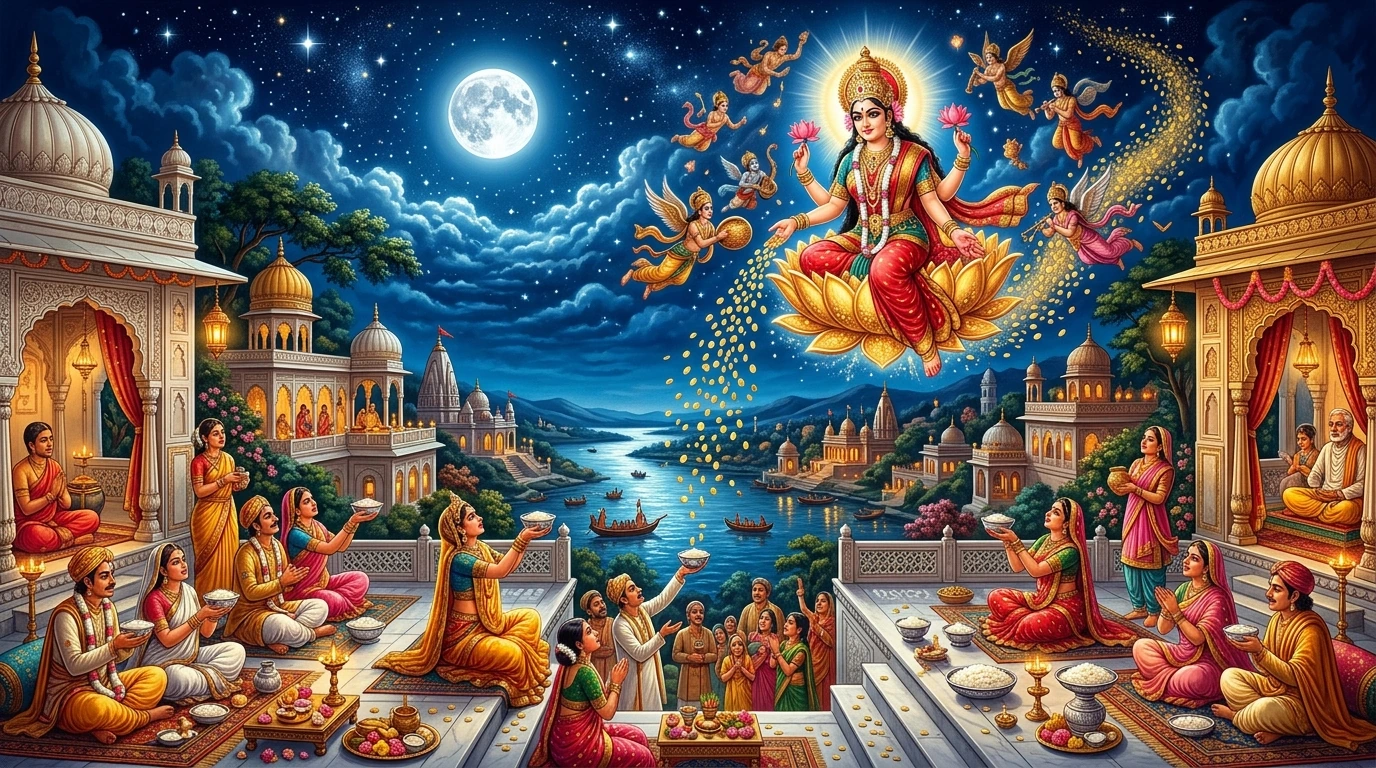
On the brightest full moon of the year, the Moon is endowed with all 16 divine potencies (Kalās) and showers nectar (Amṛta). Goddess Lakṣmī descends in the middle of the night inquiring “Ko Jāgarti?” (Who is awake and spiritually vigilant?).
The Significance of Śarad Pūrṇimā
The night the moon called
Retold from the Bhāgavata Purāṇa, Canto 10, Chapters 29 through 33 (the rāsa-līlā). The English translation relied on here is that of A.C. Bhaktivedanta Swami Prabhupāda (Bhaktivedanta Book Trust).
The autumn full moon: Śarad Pūrṇimā, is reckoned the most luminous of the year, the sky washed clean after the rains, the moon at its fullest and nearest. The Bhāgavata opens its account of this night with the moon itself:
Seeing the unbroken disc of the full moon glowing red like fresh kuṅkuma, and the forest gently lit by its rays, Kṛṣṇa took up his flute.
He played, and the sound carried into Vṛndāvana, and the gopīs, the cowherd women, left whatever they were doing, half-dressed, mid-task, and went out to him through the night, drawn past all sense and propriety by the one thing they could not resist. What follows is the rāsa-līlā, the circle dance: and the Bhāgavata says that when each gopī wished to keep Kṛṣṇa for herself, he multiplied himself, so that he stood between every two of them at once, and each danced with him as though with her alone. No one was left out, and no one possessed him. It is the tradition’s highest image of the soul and the divine, love so complete that the beloved is wholly present to each, and held by none.
There is a thread of correction in it too. When the gopīs grew proud of his favour, he vanished from the circle, and they wandered the forest calling for him, finding him only when the pride had given way to pure longing. The night is not only rapture; it is the lesson that he is reached by the heart that wants nothing for itself.
The same full moon is kept as Kojāgarī, ko jāgarti, “who is awake?”: the night the goddess Lakṣmī is said to move through the world asking exactly that, and to bless those she finds awake and watchful. So the night is spent awake: in the south and east for Lakṣmī, in the Vraja country for Kṛṣṇa’s dance.
What is done, and why
The signature observance is kṣīra: rice cooked in milk, left out under the open full moon through the night, to take in the cool nectar (amṛta) the moon’s rays are held to carry at their autumn peak, and eaten at dawn. People keep vigil, sing, and on this night especially do not sleep early: the moon, or the goddess, is abroad, and the watchful are blessed.
How it is kept
Śarad Pūrṇimā falls on the full moon (Pūrṇimā) of Āśvina, the harvest moon, the autumn’s brightest.
Why it is kept
The night gathers the year’s fullest moon, the dance in which the Lord is wholly given to each and owned by none, and the goddess who blesses the awake. All three ask the same posture: stay awake, want nothing for yourself, and the fullness comes to you.
Source: The rāsa-līlā is told in the Bhāgavata Purāṇa, Canto 10, Chapters 29–33, available at vedabase.io. Kojāgarī Lakṣmī Pūjā follows living tradition.
How it is observed
The brightest full moon: kheer is left out in the moonlight overnight and shared, and Lakṣmī is welcomed on the night she walks asking “ko jāgarti?” (who is awake?).
- Prepare traditional rice kheer using cow’s milk and sugar.
- Place the kheer in an open silver or clean dish under the direct rays of the midnight moonlight to absorb celestial nectar.
- Worship Goddess Lakṣmī and Lord Indra with white flowers and conch shells during the night vigil.
- Distribute and consume the divine moon-bathed kheer the next morning as prāsāda for health and longevity.
In Vedic astronomy, Rāhu is the shadow node (chāyā-graha) associated with illusion, darkness, and disruption. No new sacred endeavor, pūjā sankalpa, or idol installation (sthāpanā) should ever be commenced during Rāhu Kāla. Ongoing chanting or meditation may continue, but the initial invocation must never begin during this window.
Governed by Yama, the lord of mortality and justice. It is considered unfavorable for establishing enduring auspiciousness and prosperity; hence ritual beginnings and vows are suspended during this hour.