Rakṣā Bandhan
Śrāvaṇa Pūrṇimā · The full moon of the thread that binds protection
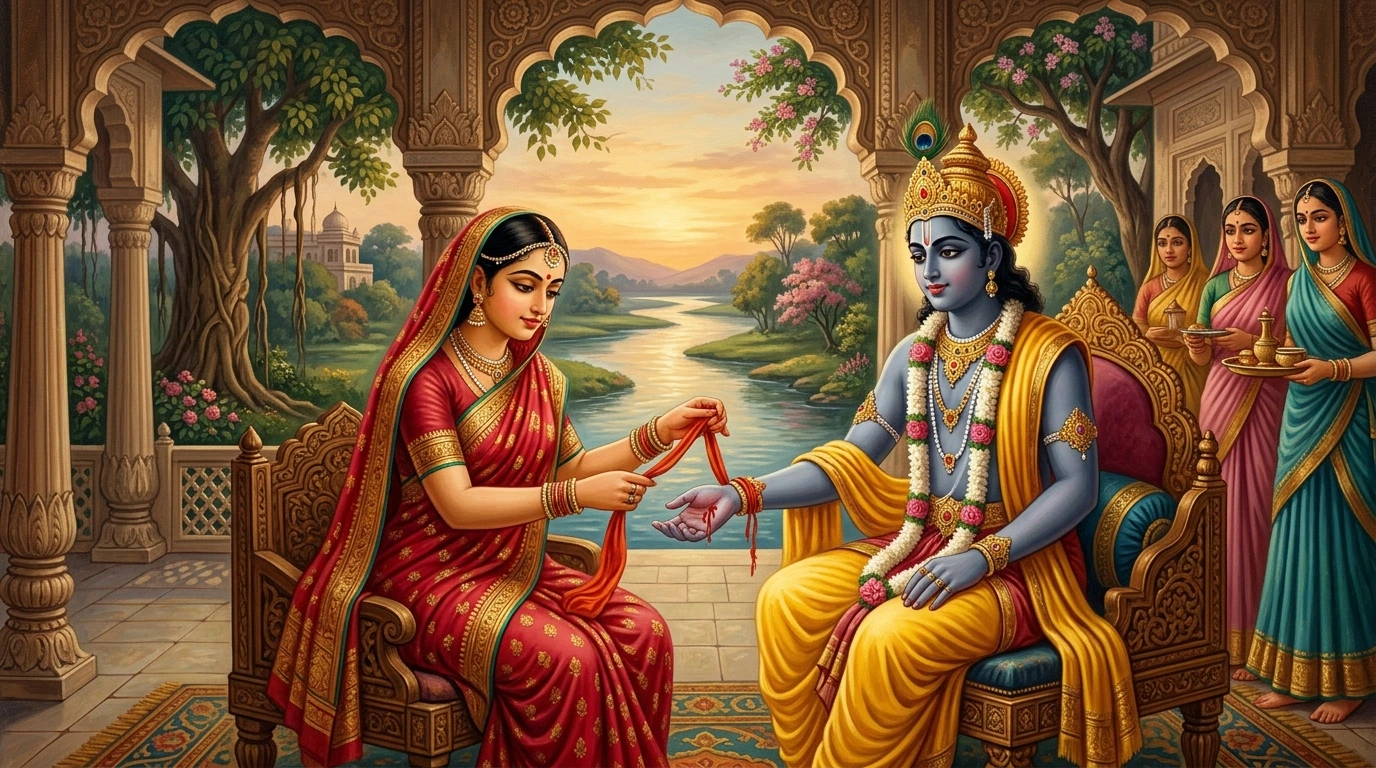
Rakṣā Bandhan
Vedic treatises designate the afternoon (Aparāhna kāla) or late morning on Śrāvaṇa Pūrṇimā as the auspicious window for sanctifying and tying the sacred thread of protection.
The Significance of Rakṣā Bandhan
The thread tied before the battle
Drawing on the Bhaviṣya Purāṇa and the Mahābhārata traditions of the protective thread.
Rakṣā bandhan means simply “the bond of protection”: a thread tied around the wrist, with a vow folded into it: I will guard you, and you me. The full moon of Śrāvaṇa is its day.
The oldest form of the story is not about brother and sister at all, but about a battle. The Bhaviṣya Purāṇa tells of a war between the gods and the asuras going badly for the gods. Before Indra returned to the fight, his consort Śacī (Indrāṇī) took a thread, charged it with her prayer and her resolve, and tied it around his wrist as a rakṣā, a guard. So armed, Indra prevailed. The thread was never a charm in itself; it was a love made tangible, worn where it could be seen.
The Mahābhārata keeps a smaller, sharper version. When Kṛṣṇa once cut his finger, Draupadī tore a strip from her sārī and bound the wound without a thought. Kṛṣṇa took the small act as a bond, and held himself her debtor, a debt he is said to have remembered in her worst hour, when her honour was being stripped in the Kaurava court and the cloth would not end. The torn strip and the endless sārī are the same thread, paid back.
From these the living custom grew: a sister ties the rakṣā to her brother, and he vows her protection, but the deeper form is older and wider than blood. The thread can be tied by a priest to a patron, by anyone to anyone whose safety they take on. It is the visible form of a promise to stand between another person and harm.
What is done, and why
On the day, the rakṣā, a simple thread, or an ornate one, is tied at the wrist with a tilaka and sweets, and the one who ties it is given a gift and, more importantly, the vow of protection in return. The act is small and the meaning is not: a relationship of mutual guarding is named out loud and worn for all to see. There is no fast.
How it is kept
Rakṣā Bandhan falls on the full moon (Pūrṇimā) of Śrāvaṇa. It is also Upākarma for many brāhmaṇas, the day the sacred thread is renewed.
Why it is kept
The festival makes a private thing public and a fleeting thing durable: it takes the unspoken promise that people who love each other will protect each other, and turns it into a thread you can see on the wrist for days. Śacī’s prayer and Draupadī’s torn cloth are both this, protection given before it is needed, and remembered when it is.
Source: The protective thread of Śacī and Indra is from the Bhaviṣya Purāṇa; the Kṛṣṇa–Draupadī bond is from Mahābhārata tradition. Translations are available at wisdomlib.org.
How it is observed
No fast, the rakṣā thread is tied by sisters on brothers for protection; brahmins renew the sacred thread (Upākarma) on this day.
- Prepare a festive thālī with a glowing dīpa, akṣata (unbroken rice), kumkum, sweets, and the rakṣā-sūtra.
- Apply an auspicious vermilion and akṣata tilak on the brother’s forehead.
- Tie the sacred rakṣā thread around the right wrist with sincere prayer for mutual well-being.
- Recite the traditional Rakṣā-sūtra blessing: “Yena baddho balī rājā dānavendro mahābalaḥ | Tena tvām anubadhnāmi rakṣe mā cala mā cala ||”
- Share sweets and exchange blessings of lasting support and honor.
In Vedic astronomy, Rāhu is the shadow node (chāyā-graha) associated with illusion, darkness, and disruption. No new sacred endeavor, pūjā sankalpa, or idol installation (sthāpanā) should ever be commenced during Rāhu Kāla. Ongoing chanting or meditation may continue, but the initial invocation must never begin during this window.
Governed by Yama, the lord of mortality and justice. It is considered unfavorable for establishing enduring auspiciousness and prosperity; hence ritual beginnings and vows are suspended during this hour.
Notice: Part of this auspicious window overlaps with Rāhu Kāla. Vedic tradition advises initiating the primary sankalpa and sacred invocation either before Rāhu Kāla begins or immediately after it concludes.
Tying the rakṣā thread during Bhadrā (Viṣṭi Karaṇa) is strictly proscribed by all Dharmashastras.