Māgha · Śukla Pakṣa

Jaya Ekadasi

Jaya Ekadasi

The victorious

Next observedTuesday, 23 February 2021

Next occurrence

Tuesday, February 23, 2021

Ekadasi tithi
Mon
22 Feb
5:16 PM
Dvādaśī begins
Tue
23 Feb
6:05 PM
Hari Vāsara ends
Tue
23 Feb
6:05 PM
Pāraṇa window
Wed
24 Feb
6:37 AM – 9:35 AM

The dancers turned to goblins

Retold from the Padma Purāṇa, Uttara Khaṇḍa, Chapter 43. The standard English translation, on which this retelling relies, is by N.A. Deshpande (Motilal Banarsidass).

This is a story about a missed beat in a song, and what it cost.

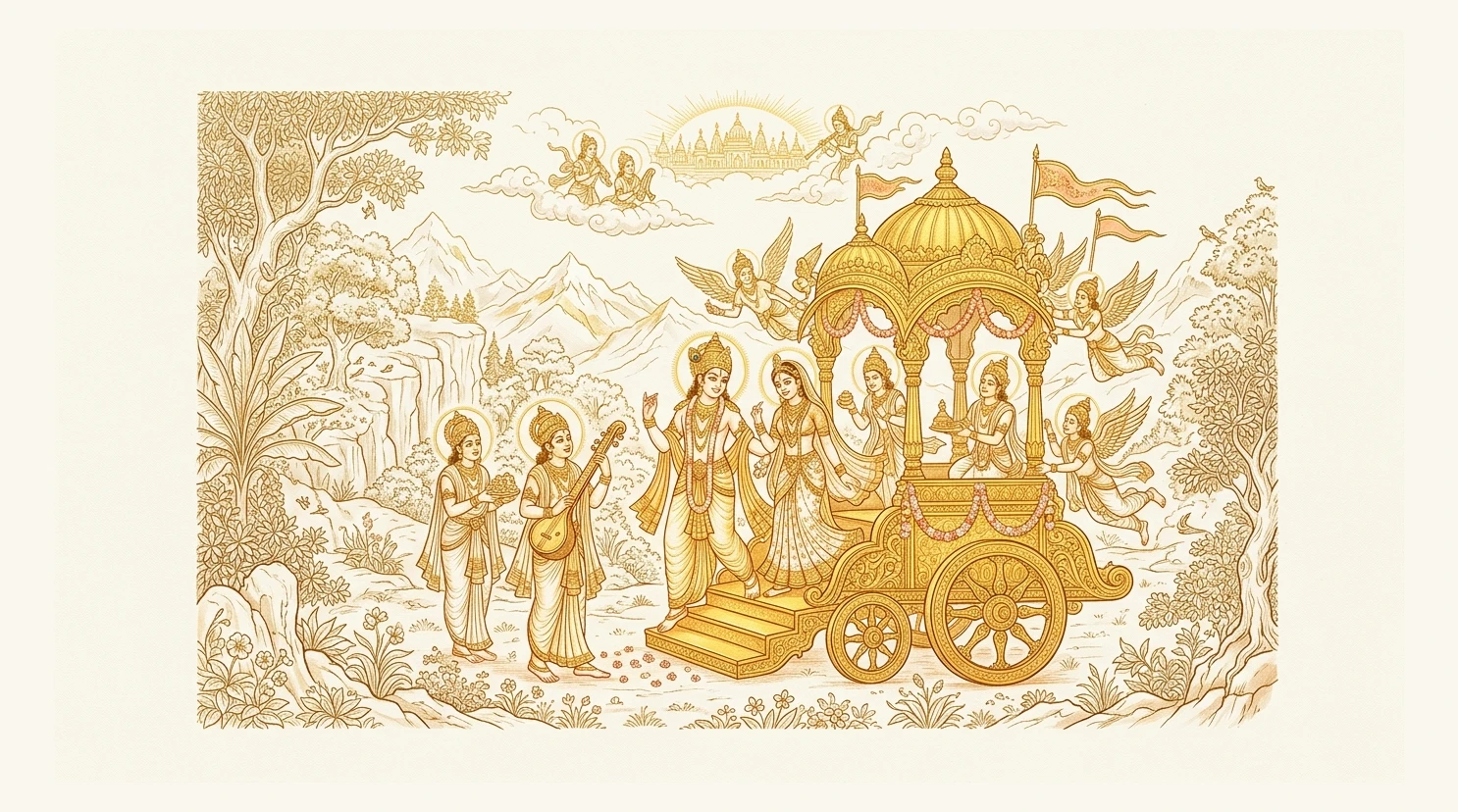
In heaven, where Indra rules fifty crores of inhabitants and the celestial nymphs serve nectar, there is a grove called Nandana. Pārijāta trees grow in it. Gods rejoice there, attended by nymphs. Among the gandharvas who sing for these rejoicings were a young man and a young woman who happened to love each other.

His name was Mālyavat. He was the son of the gandharva Puṣpadanta. She was Puṣpadantī, born of Mālinī, who was Citrasena’s wife. They were musicians by birth, beautiful by inheritance, and infatuated with each other in a way the Purāṇa describes at length: her arms were like Cupid’s nooses, her eyes long to the ears and reeling, her breasts like golden pitchers, her waist so lean it could be grasped in a fist. He was filled with the feeling of love just looking at her.

One day they were called to perform before Indra. They came together: singing and dancing, attended by bands of nymphs, both of them dressed and adorned for the occasion. But their attention was on each other. The text is gentle about what happened next, almost apologetic on their behalf. Their bodies were filled with cupid. Their minds were perplexed. They missed the rhythm. The clapping of their hands fell out of time. Their feet drifted from the measure. The execution of the song faltered.

Indra noticed.

The king of the gods felt insulted. His jealousy was the jealousy of a powerful man who senses, accurately, that something has been taken from him, the full attention of his entertainers. Fie upon you, he said. You stupid ones have disobeyed me. Be turned into goblins as husband and wife. Go to the mortal world, enjoying the fruit of your deed.

The curse worked instantly. They fell.

They landed on the Himalaya: not at its base, but somewhere in its impassable upper reaches, where the snow does not melt. Their bodies had changed. They were pishachas now, goblins. The cold tore at them. The summer, when it came, was worse. They moved through mountain caves with their teeth chattering and the hair of their bodies standing up in fear and pain. They could not sleep at night. They did not have coition. They got no pleasure. The Purāṇa permits itself one observation: Hell is looked upon as fierce, and goblin-hood as painful.

In one of the caves, the male goblin spoke to the female. What great, fierce, and thrilling sin have we committed, he asked, due to which we have obtained goblin-hood as the result of our bad deeds? With all efforts, one should not commit a sin. It is the kind of question people ask when they have learned the lesson but cannot yet undo what brought them to it.

Then the Ekādaśī of Māgha: the bright fortnight, the one called Jayā, arrived in the world, and it arrived also in the cave. The two goblins, in their misery, did the things the Ekādaśī asks for, without knowing they were doing them. They did not eat. They did not drink. They did not kill any creature for meat, as goblins are otherwise inclined to do. They did not eat leaves or fruits. They sat near an Aśvattha tree, full of grief, clinging to each other in their changed bodies. The night came: fierce, terrible, fatal, and they slept on the bare ground. They did not sleep, actually. There was no coition. There was no pleasure. Their bodies, which had failed to keep time at Indra’s court, now kept the vow of Jayā by being unable to do anything else.

Kṛṣṇa, watching, held their salvation in his heart. When the morning of Dvādaśī came, the curse lifted. Their goblin-bodies fell away. Mālyavat and Puṣpadantī stood in their old forms with their old ornaments, their old love between them, unaltered.

A vimāna: an aerial vehicle, appeared, and they rose in it through the sky and came again to Indra’s court. They saluted him. Indra looked at them, astonished. Tell me, he said, due to what moral merit, you who were reduced to goblin-hood, who had received a curse from me, by which god were you freed?

Mālyavat answered: Our goblin-hood has gone by Viṣṇu’s favour, the observance of the Jayā-vow, and the strength of devotion to you.

Indra paused. Then he said something that the Purāṇa preserves as one of its rare moments of one god conceding the rank of another. You have become sinless, pure, and have become adorable even to me. There is no doubt that those mortals who adhere to the vow of the day of Viṣṇu, and are devoted to Kṛṣṇa, are adorable to us also.

The vow

Jayā Ekādaśī is observed on the eleventh tithi of the bright fortnight of Māgha. The fast is broken on Dvādaśī. The observance is standard: fasting from sunrise to sunrise, worship of Viṣṇu, keeping awake through the night, breaking the fast in the pāraṇa window the following morning.

This Ekādaśī is observed by those who fear they have lost their place. It is not a vow asked for; it is a vow that pulls those who have already fallen up out of their fall. The Purāṇa specifically describes it as the destroyer of the state of being a goblin, but the goblin is a stand-in for any condition into which a person has been cast by the heedlessness of a moment.

The phalaśruti

The chapter is unusually direct about the merit. Jayā removes the sin of a brāhmaṇa’s murder. The observer has given all gifts, has performed all sacrifices. They rejoice in Vaikuṇṭha for a crore of kalpas, a kalpa being one day of Brahmā, which is itself roughly 4.32 billion years. The arithmetic is not the point. The point is permanence.

There is one more thing this story teaches that the phalaśruti does not name. Cupid pulled the dancers off-rhythm. Love made them careless. The vow restored them not by punishing the love but by burning out what their carelessness had cost. They returned to the same court, in the same forms, with the same love between them. The vow does not remove what one cherishes. It removes what one has done in despair of cherishing it.

Source: Padma Purāṇa, Uttara Khaṇḍa, Chapter 43, “Jayā Ekādaśī.” Translated by N.A. Deshpande in Ancient Indian Tradition and Mythology series, vols. 39–48 (Motilal Banarsidass, Delhi, ISBN 9788120838291). The full English translation is freely available at wisdomlib.org.

New to the vrata? Read the full Ekadashi fasting rules : what to eat, what to avoid, the three intensities of fast, and how to break it (pāraṇa).

Frequently asked

What is Jaya Ekadasi?
Jaya Ekadasi is the ekādaśī tithi, the eleventh lunar day, of the waxing fortnight (śukla pakṣa) of Māgha. Its name means "the victorious". Like every Ekadasi, it is observed by fasting and remembrance of Lord Viṣṇu. The story and fruits (phalaśruti) of Jaya are recorded in Padma Purāṇa, Uttara Khaṇḍa, Chapter 43.
When is Jaya Ekadasi observed?
Jaya Ekadasi falls on the ekādaśī tithi of the waxing fortnight of Māgha (the Hindu lunar month). The exact Gregorian date varies each year because the lunar calendar drifts relative to the solar one. Smārta and Vaiṣṇava observers occasionally fast on different civil days when the tithi spans two sunrises, see the date above for the next occurrence.
Who is worshipped on Jaya Ekadasi?
Jaya Ekadasi, like all Ekadasis, is dedicated to Viṣṇu. Specific forms of worship vary by tradition: chanting Viṣṇu-sahasranāma, reading the corresponding chapter from Padma Purāṇa, Uttara Khaṇḍa, Chapter 43, hearing the story, and remembering the divine names are all considered part of the observance.
What is the spiritual fruit (phalaśruti) of observing Jaya Ekadasi?
The Purāṇic source declares that observing Jaya Ekadasi yields: Removes the sin of murdering a brāhmaṇa; the observer rejoices in Vaikuṇṭha for a crore of kalpas. Across all Ekadasis, the underlying claim is the same, the fast aligns the body, breath, and mind with the eleventh lunar day's particular quietness, and bestows merit equivalent to extensive austerities, charity, or pilgrimage.
How is Jaya Ekadasi observed?
A complete observance begins the previous evening with a light, sattvic meal and continues into a fast on Ekadasi day. The fast can be nirjala (without water), phalāhāra (fruits and water), or a single sattvic meal, pick the level your health and discipline allow. Grains, pulses, onions, and garlic are universally avoided on Ekadasi. The fast is broken on Dvādaśī during the prescribed pāraṇa window listed on this page. The day is spent in remembrance, chanting, reading, hearing the Ekadasi story, and avoiding sleep during daylight where possible.
What is the difference between Smārta and Vaiṣṇava observance of Jaya Ekadasi?
On most Ekadasis the two traditions fast on the same day. They diverge only in the rare atirikta case, when the Ekadasi tithi spans two consecutive sunrises. Smārtas fast on the first such day; Vaiṣṇavas wait until the next, preferring that Dvādaśī also touches sunrise. If Jaya Ekadasi falls in such a fortnight in a given year, the two dates will appear on this page side by side.

Found an error?

ekadasi.day has no ads and no popups. If a date, name, or story reads wrong, please write, accuracy matters more than reach.

feedback@ekadasi.day →·Other ways to help

Panchang for this Ekadasi

सङ्कल्पः · saṅkalpaḥ

Tuesday, 23 February, in the old reckoning

  1. अद्य · श्वेतवराह कल्पे · वैवस्वत मन्वन्तरे · कलियुगे प्रथम पादे

    adya · śveta-varāha kalpe · vaivasvata manvantare · kali-yuge prathama pāde

  2. शालिवाहन शके १९४२ · शार्वरी संवत्सरे · उत्तरायणे · शिशिर ऋतौ

    śālivāhana śake 1942 · Śārvarī saṁvatsare · Uttarāyaṇe · Śiśira ṛtau

  3. फाल्गुन मासे · शुक्ल पक्षे · एकादशी तिथौ · मङ्गल वासरे · आर्द्रा नक्षत्रे · आयुष्मान् योगे · विष्टि करणे

    Phālguna māse · Śukla pakṣe · Ekādaśī tithau · Maṅgala vāsare · Ārdrā nakṣatre · Āyuṣmān yoge · Viṣṭi karaṇe

  4. जम्बूद्वीपे · भारतवर्षे*

    jambū-dvīpe · bhārata-varṣe (India)

*The locality lines, jambū-dvīpe bhārata-varṣe, your deśa and your kṣetra: name your continent, country, region, and town. India is shown by default; spoken aloud you'd substitute your own.

What you just read

The sankalpa is the opening declaration of any traditional Hindu observance. It places the moment in three nested frames, cosmic, calendrical, and astronomical, before any act, so the doer knows when and where they are standing in time.

Cosmic time doesn't change with where you read this. Śveta-varāha is the present kalpa (a day of Brahmā, ~4.32 billion years). Vaivasvata is the current manvantara within it. Kali-yuga prathama pāda places us in the first quarter of the dark age. These are the deepest layers of the Hindu reckoning of time, the same for someone in Bengaluru, Mumbai, Sydney, or San Francisco.

Calendrical time tracks the present year. The Śaka era counts from 78 CE; the named saṁvatsara is one of a sixty-year cycle of year-names (Prabhava, Vibhava... Akṣaya, then repeating). The ayana tells us which half of the solar year we're in: Uttarāyaṇa (sun moving north, January to July) or Dakṣiṇāyana (south, July to January). The ṛtu is the season.

Astronomical time is the most particular. The māsa, pakṣa, and tithi follow the moon; the vāra is the weekday; the nakṣatra is which of the 27 lunar mansions the moon currently sits in; the yoga is a sun-plus-moon arithmetic; the karaṇa is the half-tithi. These four: nakṣatra, yoga, tithi, karaṇa, together with the vāra are the literal "five limbs" of the word pañchāṅga.

The values shown above are computed for your local sunrise. The day "belongs to" whichever tithi (and nakṣatra and karaṇa) was prevailing at sunrise, even if those quantities change mid-morning, the day keeps its sunrise name until the next sunrise. This is the convention every printed panchang and every traditional sankalpa uses. A reader in Sydney sees their sunrise's reckoning; a reader in London sees theirs; both differ from each other by a few hours of the sky.

Why it is spoken every day. The sankalpa is the traditional opening of daily (nitya) observance, not reserved for festivals. Recited each morning, it re-anchors you in the exact moment you occupy in sacred time and dedicates the day’s actions with conscious intention (saṅkalpa means “resolve”). On an Ekadasi it is the same declaration that opens the fast, the day, the place, and the purpose, named before the vrata begins.

Sky on 23 February 2021

Sun

Rises6:38 AM100° E
Sets6:27 PM260° W

Moon

Rises2:49 PM64° ENE
Sets3:12 AM296° WNW

Rahu kāla

3:30 PM – 4:58 PM

Yamaganda kāla

9:35 AM – 11:04 AM

Abhijit muhūrta

12:09 PM – 12:57 PM

Bearings are degrees on the horizon (0° N, 90° E, 180° S, 270° W). Rahu and Yamaganda are traditionally avoided for new undertakings. Abhijit is the brief auspicious window centred on local noon.