Jagannātha Ratha Yātrā
Āshāḍha Śukla Dvitīyā · The Lord who comes out of the temple to meet everyone
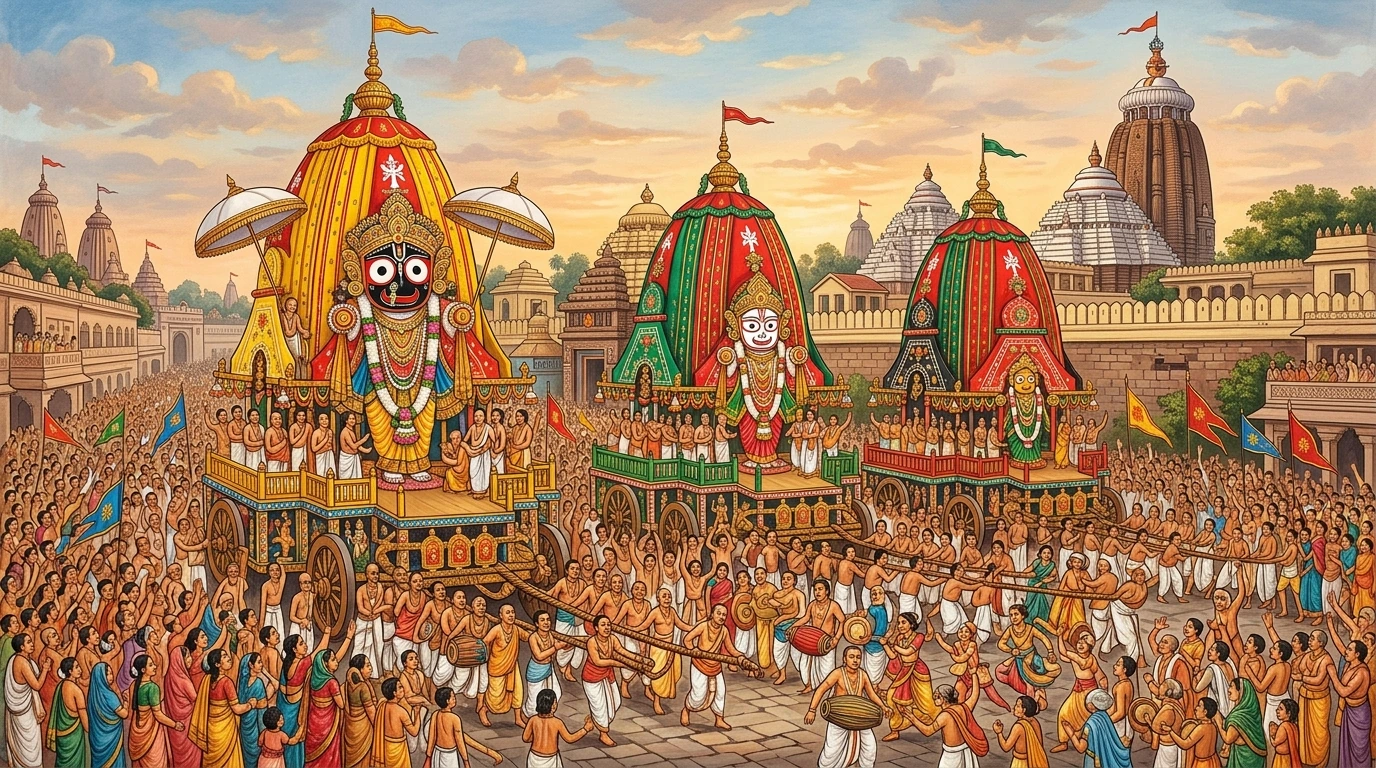
Jagannātha Ratha Yātrā
Lord Jagannātha, Balabhadra, and Subhadrā leave the inner sanctum of the Śrī Mandira in the grand Pahandi procession to mount their celestial chariots, offering unconditional mercy to all souls without distinction.
The Significance of Jagannātha Ratha Yātrā
The Lord leaves his house
Drawing on the Skanda Purāṇa (Utkala Khaṇḍa) and the Brahma Purāṇa, which carry the tradition of Jagannātha and the chariot festival at Purī.
At Purī, in Odisha, the Lord is worshipped as Jagannātha, “lord of the universe”, together with his brother Balabhadra and sister Subhadrā. Their images are unlike any others: great-eyed, armless wooden forms, deliberately unfinished. The tradition explains why. The images were to be carved by the divine craftsman, who agreed on one condition, that he work behind closed doors, undisturbed, until finished. The king (or queen), unable to bear the long silence, opened the door too soon. The craftsman vanished, and the forms were left as they were, incomplete, all eyes and no hands. And so the Lord chose to remain: not as a perfect icon, but in a form that looks unfinished, that meets the devotee exactly as he is.
Once a year, the three do something no temple deity ordinarily does: they leave the temple. On Āṣāḍha Śukla Dvitīyā, the images are brought out, placed on three colossal wooden chariots, and pulled through the streets by thousands of hands along the Grand Road to the Guṇḍicā temple, where they stay some days before returning. The chariots are rebuilt new every year. The ropes are open to everyone.
This is the heart of the festival. On every other day, the devotee must go to the Lord’s house and stand where the rules of the temple place him. On this one day the Lord comes out, onto the open road, where caste and rank and the rules of entry fall away, and the lowest and the highest pull the same rope. The Lord who looks unfinished comes to where the people are, and is touched by all of them. Caitanya Mahāprabhu danced before these chariots; the festival is dear to the Gauḍīya Vaiṣṇavas as the day Kṛṣṇa returns, in longing, to those who love him.
What is done, and why
The observance is the pulling itself, darśana of the Lord on the open road, and a hand on the rope, which is held to carry great merit. There is no household fast; it is a festival of procession, song, and the sweet poḍa-pīṭha offered to Jagannātha. The deeper act is the meaning: to be met by the Lord halfway, outside the walls.
How it is kept
Ratha Yātrā begins on Āṣāḍha Śukla Dvitīyā (the second day of the bright fortnight). The return journey, Bahuḍā Yātrā, falls some days later.
Why it is kept
The whole festival is one gesture: the Lord stepping out of his own temple to meet everyone on common ground. The unfinished form and the open road say the same thing, that he comes to people as they are, and lets himself be reached by hands that could never enter the sanctum.
Source: The tradition of Jagannātha, the unfinished forms, and the chariot festival is carried in the Skanda Purāṇa (Utkala Khaṇḍa) and the Brahma Purāṇa. Translations are available at wisdomlib.org.
How it is observed
No fast: the festival of the chariot procession, when Jagannātha, Balabhadra and Subhadrā are drawn through the streets and even those who cannot enter the temple receive darśana.
- Chant the holy names of Jagannātha, Balabhadra, and Subhadrā with kīrtana and cymbals.
- Touch or pull the ropes of the sacred chariot (believed in the Brahma Purāṇa to liberate one from the cycle of rebirth).
- Offer fresh seasonal fruits, coconuts, and traditional sweet piṭhas to the Lord of the Universe.
In Vedic astronomy, Rāhu is the shadow node (chāyā-graha) associated with illusion, darkness, and disruption. No new sacred endeavor, pūjā sankalpa, or idol installation (sthāpanā) should ever be commenced during Rāhu Kāla. Ongoing chanting or meditation may continue, but the initial invocation must never begin during this window.
Governed by Yama, the lord of mortality and justice. It is considered unfavorable for establishing enduring auspiciousness and prosperity; hence ritual beginnings and vows are suspended during this hour.
Notice: Part of this auspicious window overlaps with Rāhu Kāla. Vedic tradition advises initiating the primary sankalpa and sacred invocation either before Rāhu Kāla begins or immediately after it concludes.