
Parama Ekadasi

Adhika Māsa · Kṛṣṇa Pakṣa · Parama Ekadasi
Next ObservanceSaturday, 11 June 2140
Presiding Darśana Vigraha
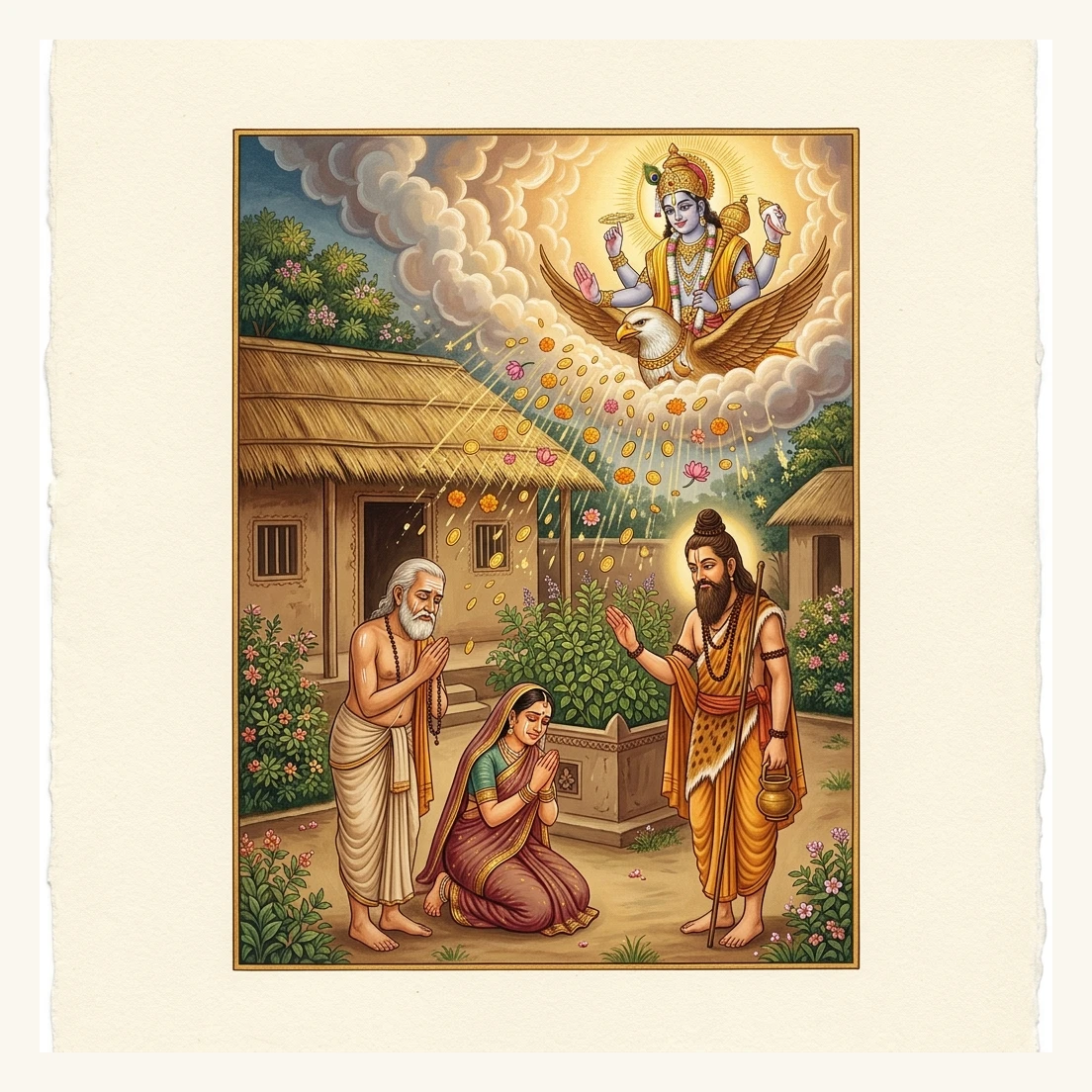
Pavitrā serving her last food to a guest as Lord Viṣṇu showers golden celestial abundance upon the humble home
Adhika Māsa: In deep poverty, the virtuous Pavitrā offers her final food to a guest; her unhesitating hospitality is rewarded with Lord Viṣṇu’s boundless shower of divine abundance.
Adhika Māsa · Kṛṣṇa Pakṣa

Parama Ekadasi

Fasting Active · Sunrise to Sunrise
Fasting Injunction · Upavāsa Active Fast
Sacred 24-Hour Fast Window
5:53 AM – 5:53 AM (Next Dawn)

Saturday, June 11, 2140

Pāraṇa Window (Breaking the Fast)Dvādaśī Morning
5:53 AM – 9:06 AM

Break after sunrise (5:53 AM) with Caraṇāmṛta & Tulasī leaf before Dvādaśī ends.

Phalahāra

Fresh fruits, milk, nuts, sabudana, water.

Varjya

Grains, rice, wheat, dal, beans, onion, garlic.

View Astronomical Tithi Timings Table ▾
Ekadasi tithi
Fri
10 Jun
9:29 PM
Dvādaśī begins
Sat
11 Jun
6:31 PM
Hari Vāsara ends
Sat
11 Jun
6:31 PM
Pāraṇa window
Sun
12 Jun
5:53 AM – 9:06 AM
Detailed Fasting Injunctions

1. Pre-dawn sanctity: Breaking the fast while still dark invalidates the vrata. Always await local sunrise.

2. Dvādaśī adherence: The fast must be broken before Dvādaśī tithi elapses to retain spiritual fruit.

3. Sacred Order: Offer prayers to Lord Viṣṇu, sip sacred Caraṇāmṛta with Tulasī, then partake of light food.

Need guidance on observances? Read the canonical Ekādaśī Fasting Rules : what to eat, what to avoid, the three vrata intensities, and breaking rules (pāraṇa).

Frequently asked

What is Parama Ekadasi?
Parama Ekadasi is the ekādaśī tithi, the eleventh lunar day, of the waning fortnight (kṛṣṇa pakṣa) of Adhika Māsa. Its name means "the supreme". Like every Ekadasi, it is observed by fasting and remembrance of Lord Viṣṇu. The story and fruits (phalaśruti) of Parama are recorded in Skanda Purāṇa.
When is Parama Ekadasi observed?
Parama Ekadasi falls on the ekādaśī tithi of the waning fortnight of Adhika Māsa (the Hindu lunar month). The exact Gregorian date varies each year because the lunar calendar drifts relative to the solar one. Smārta and Vaiṣṇava observers occasionally fast on different civil days when the tithi spans two sunrises, see the date above for the next occurrence.
Who is worshipped on Parama Ekadasi?
Parama Ekadasi, like all Ekadasis, is dedicated to Viṣṇu (as Puruṣottama). Specific forms of worship vary by tradition: chanting Viṣṇu-sahasranāma, reading the corresponding chapter from Skanda Purāṇa, hearing the story, and remembering the divine names are all considered part of the observance.
What is the spiritual fruit (phalaśruti) of observing Parama Ekadasi?
The Purāṇic source declares that observing Parama Ekadasi yields: An enjoyable life and release from birth and death; the Pancharātrika five-day fast destroys all sins; observed only in the leap month. Across all Ekadasis, the underlying claim is the same, the fast aligns the body, breath, and mind with the eleventh lunar day's particular quietness, and bestows merit equivalent to extensive austerities, charity, or pilgrimage.
How is Parama Ekadasi observed?
A complete observance begins the previous evening with a light, sattvic meal and continues into a fast on Ekadasi day. The fast can be nirjala (without water), phalāhāra (fruits and water), or a single sattvic meal, pick the level your health and discipline allow. Grains, pulses, onions, and garlic are universally avoided on Ekadasi. The fast is broken on Dvādaśī during the prescribed pāraṇa window listed on this page. The day is spent in remembrance, chanting, reading, hearing the Ekadasi story, and avoiding sleep during daylight where possible.
What is the difference between Smārta and Vaiṣṇava observance of Parama Ekadasi?
On most Ekadasis the two traditions fast on the same day. They diverge only in the rare atirikta case, when the Ekadasi tithi spans two consecutive sunrises. Smārtas fast on the first such day; Vaiṣṇavas wait until the next, preferring that Dvādaśī also touches sunrise. If Parama Ekadasi falls in such a fortnight in a given year, the two dates will appear on this page side by side.

Found an error?

ekadasi.day has no ads and no popups. If a date, name, or story reads wrong, please write, accuracy matters more than reach.

feedback@ekadasi.day →·Other ways to help

Panchang for this Ekadasi

सङ्कल्पः·SAṄKALPAḤ

Saturday, 11 June, in the old reckoning

  1. Cosmic Time

    अद्य · श्वेतवराह कल्पे · वैवस्वत मन्वन्तरे · कलियुगे प्रथम पादे

    adya · śveta-varāha kalpe · vaivasvata manvantare · kali-yuge prathama pāde

  2. Calendrical Time

    शालिवाहन शके २०६२ · शार्वरी संवत्सरे · उत्तरायणे · ग्रीष्म ऋतौ

    śālivāhana śake 2062 · Śārvarī saṁvatsare · Uttarāyaṇe · Grīṣma ṛtau

  3. Astronomical Limb (Pañcāṅga) · पञ्चाङ्ग कालः

    अधिक आषाढ मासे · कृष्ण पक्षे · एकादशी तिथौ · शनि वासरे · रेवती नक्षत्रे · शोभन योगे · बव करणे

    Adhika Āṣāḍha māse · Kṛṣṇa pakṣe · Ekādaśī tithau · Śani vāsare · Revatī nakṣatre · Śobhana yoge · Bava karaṇe

  4. Sacred Locality

    जम्बूद्वीपे · भारतवर्षे*

    jambū-dvīpe · bhārata-varṣe (India)

*The locality lines, jambū-dvīpe bhārata-varṣe, your deśa and your kṣetra: name your continent, country, region, and town. India is shown by default; spoken aloud you'd substitute your own.

Vedic Understanding

What You Just Read: The Three Frames of Time

The saṅkalpa places the moment in three nested dimensions—cosmic, calendrical, and astronomical—so the seeker knows exactly when and where they stand in eternity.

I

Cosmic Time (Eternal Scale)

Cosmic time doesn’t change with where you read this. Śveta-varāha is the present kalpa (a single day of Brahmā, ~4.32 billion human years). Vaivasvata is the current manvantara (epoch) within it. Kali-yuga prathama pāda places us in the first quarter of the dark age. These are the deepest layers of the Hindu reckoning of time, identical whether recited in Bengaluru, Mumbai, London, Sydney, or San Francisco.

II

Calendrical Time (Solar & Seasonal Cycles)

Calendrical time tracks the present era and season. The Śaka era counts from 78 CE; the named saṁvatsara is one of a sixty-year Jovian cycle (Prabhava, Vibhava... Akṣaya, then repeating). The ayana indicates the solar half-year: Uttarāyaṇa (sun ascending north, January to July) or Dakṣiṇāyana (sun descending south, July to January). The ṛtu names the sacred bi-monthly season.

III

Astronomical Time (The Five Limbs of Pañchāṅga)

Astronomical time is the most immediate. The māsa (lunar month), pakṣa (fortnight), and tithi (lunar phase) follow the moon; the vāra is the solar weekday; the nakṣatra is which of the 27 stellar constellations the moon currently occupies; the yoga is combined solar-lunar longitude; and the karaṇa is the half-tithi. Together, these five (nakṣatra, yoga, tithi, karaṇa, vāra) form the literal “five limbs” of the word pañchāṅga.

Local Sunrise Reckoning & Daily Purpose

All values above are calculated for your local sunrise. The day traditionally “belongs” to whichever tithi prevailed at the moment of sunrise. Even if the tithi changes mid-morning, the day retains its sunrise name for rituals until the next sunrise. This is the authentic convention observed across printed panchangas and traditional temples worldwide.

Why it is spoken every day: The saṅkalpa is the daily (nitya) opening of sacred life, not reserved solely for grand festivals. Recited each morning, it re-anchors you in conscious awareness of eternity and dedicates your actions with pure resolve (saṅkalpa literally means “sacred will or resolve”). On an Ekādaśī, this same declaration formally opens the fast.

Sky on 11 June 2140

Celestial Coordinates & Muhūrtas

Sūrya · SunDay Arc
Sunrise5:53 AM66° ENE
Sunset6:46 PM294° WNW
Candra · Moon
Moonrise2:06 AM76° ENE
Moonset3:02 PM287° WNW
Rāhu Kāla

9:06 AM – 10:42 AM

Yamagaṇḍa

1:56 PM – 3:32 PM

Abhijit Muhūrta

11:55 AM – 12:43 PM

Bearings indicate horizon degrees. Rāhu and Yamagaṇḍa are avoided for new auspicious beginnings; Abhijit is the midday victory window.